
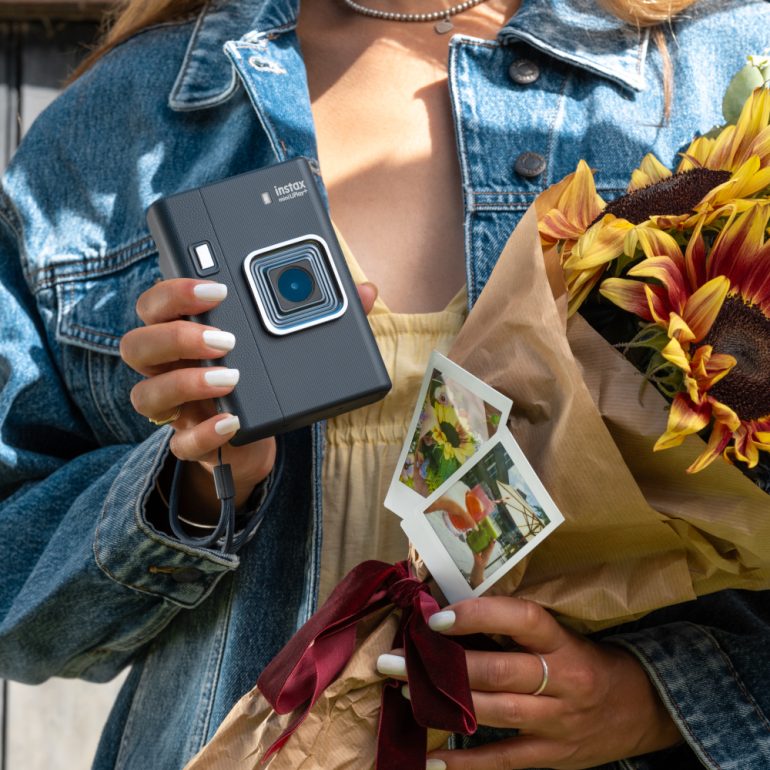
When Fujifilm announced the Instax Mini LiPlay+, the obvious thing to talk about is new hardware. It’s the first Instax camera with a dual-camera setup. It can attach audio recordings to printed photographs through QR codes. It doubles as a smartphone printer. On a spec sheet, those are the headlines. But they’re probably not the reason people will buy it.
Instant photography has always been an irrational purchase. Smartphones take objectively better photographs, store thousands of them, edit them in seconds and share them with anyone in the world almost instantly. By almost every conventional measure, carrying a second camera that prints tiny credit card-sized photographs makes very little sense. Yet Instax has become one of Fujifilm’s most successful consumer products, while entire categories of traditional cameras have quietly disappeared.
That isn’t because people suddenly decided image quality doesn’t matter. It’s because image quality stopped being the thing they were looking for.
The conversation around smartphone photography has become increasingly technical over the past few years. Every launch promises larger sensors, brighter lenses, more capable AI and another leap in computational photography. Those improvements are real, but they’ve also become expected. Very few people look at a modern flagship smartphone and think, “If only the camera were a little sharper.”
The question has changed. Instead of asking how to take a better photograph, more people are beginning to ask which photographs are actually worth doing something with.
That’s the space Instax occupies, and it’s why the Mini LiPlay+ feels more significant than another annual refresh. Fujifilm isn’t trying to persuade people to replace their smartphone camera. The company accepted years ago that smartphones had already won that battle. Instead, it’s building products around something smartphones still haven’t replicated particularly well: giving photographs a life beyond the camera roll.
There’s an irony to that strategy. Smartphones have made photography almost completely frictionless. We photograph meals we’ll forget, concerts we’ll never watch back and holidays that disappear beneath screenshots, WhatsApp images and receipts. The problem isn’t that we don’t have enough photographs. It’s that we’ve become remarkably good at creating images and remarkably bad at returning to them.
A printed photograph changes that relationship. Not because it’s technically superior, but because it’s harder to ignore. It sits on a desk instead of inside a gallery app. It gets tucked into a wallet, pinned to a fridge or slipped into a birthday card. Over time, it stops behaving like digital content and starts behaving like an object with a history. That’s something smartphones have never quite managed to recreate, regardless of how sophisticated their cameras have become.
The Instax Mini 41 leaned heavily into that analogue appeal. It celebrated the experience of instant photography without trying to modernise it too aggressively. The Mini LiPlay+ takes a different approach. Rather than pretending digital photography doesn’t exist, it accepts that smartphones are already at the centre of most people’s lives and asks how instant photography can fit naturally alongside them instead.
That’s why the camera’s hybrid design matters more than any individual specification. Like the original LiPlay, it allows users to capture photographs digitally before deciding whether they’re worth printing, while also functioning as a printer for images already stored on a smartphone. That sounds like a small convenience, but it quietly changes the relationship between photography and printing. Printing is no longer something that happens because you happened to be using a particular camera. It becomes a conscious decision about which photographs deserve to leave your phone and exist somewhere else.
That feels increasingly relevant because the value of a photograph has never really been determined by how easy it was to take. If anything, the opposite has often been true. The photographs people treasure most usually aren’t the technically perfect ones. They’re the ones attached to a person, a place or a moment that can’t be repeated. Fujifilm’s latest Instax camera doesn’t change that. It simply recognises that in an age of unlimited digital photography, choosing what to print has become just as important as choosing what to photograph.
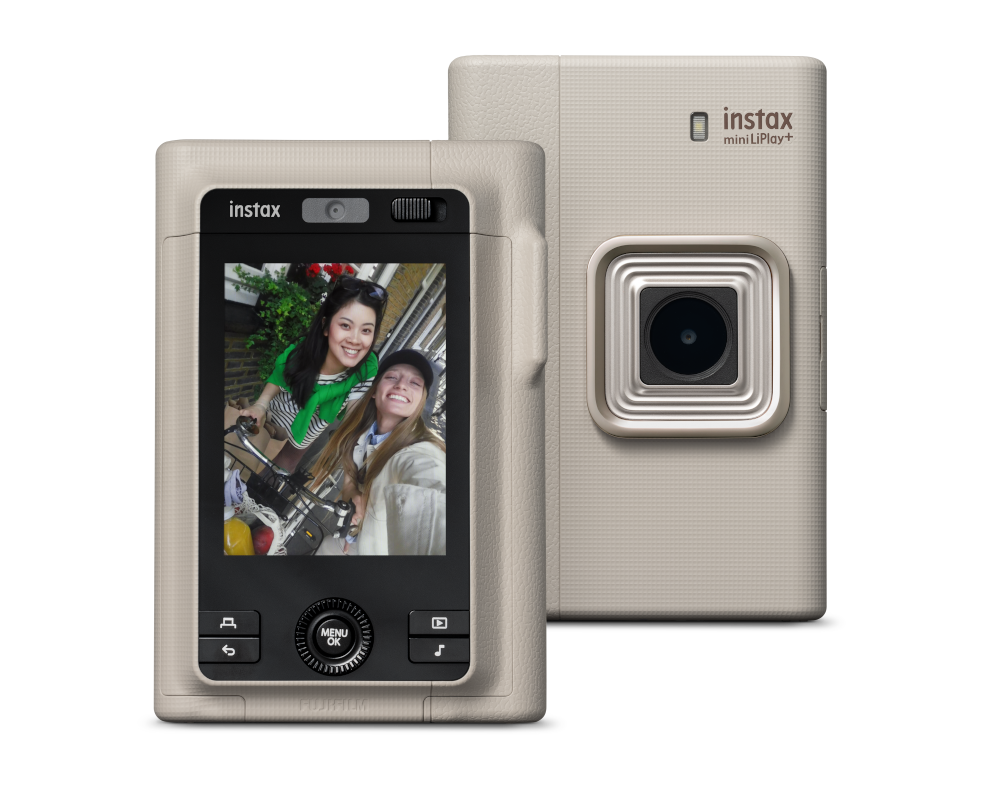
That philosophy becomes clearer once you look at what Fujifilm has actually changed. The Mini LiPlay+ is the first Instax camera to feature a dual-camera setup, pairing its primary camera with a dedicated wide-angle selfie camera on the rear. The combination makes group shots easier while introducing a new Layered Photo mode that merges images from both cameras into a single print. Additional creative filters, improved automatic exposure and flash control, together with a choice between Instax Natural and Instax Rich print modes, round out the updates. None of those features is revolutionary in isolation. Their significance lies in what they reveal about how Fujifilm thinks people now use instant photography.
Previous generations of Instax cameras largely celebrated spontaneity. You pointed, pressed the shutter and accepted whatever emerged from the film a few moments later. The Mini LiPlay+ moves away from that philosophy without abandoning it entirely. By letting users preview images before printing them, Fujifilm acknowledges that instant film is no longer something people are willing to waste. Every print has become a deliberate choice rather than a happy accident.
That evolution says as much about consumer behaviour as it does about the camera itself. Digital photography removed the cost of experimentation. We can take twenty versions of the same photograph because deleting the nineteen failures costs nothing. Printing, however, still carries value. Film isn’t free, and neither is the space a photograph occupies once it leaves the camera. Choosing to print an image remains one of the few moments in modern photography where we’re forced to decide whether a memory is worth preserving in a more permanent form.
That’s also why Sound Print is arguably the camera’s most interesting addition. Through the companion app, users can attach a voice recording or ambient sound to a printed photograph using a QR code, while the new Sound Album feature creates a slideshow with music that can also be accessed by scanning a printed code. It’s easy to dismiss both features as novelties, particularly when QR codes have become the technology industry’s solution to almost everything. Even so, the idea behind them deserves more attention than the technology itself.
A photograph has never captured an entire memory. It freezes a fraction of a second, but it leaves out almost everything else. The conversation that happened moments before. The laughter behind the camera. The sound of the sea, the rain or the city street. Years later, those details often matter as much as the image itself. Sound Print doesn’t recreate a memory in its entirety, but it acknowledges that photographs have always been incomplete records of our lives.
Whether people embrace the feature is another question. Technology companies often assume that useful features naturally become everyday habits, but history suggests otherwise. The products that endure are usually the ones that ask very little of the people using them. Fujifilm’s challenge won’t be proving that Sound Print works. It’ll be convincing people that recording a few seconds of audio becomes as instinctive as taking the photograph itself.
What’s notable is how restrained Fujifilm has been elsewhere. Artificial intelligence barely features in the Mini LiPlay+ story despite becoming the dominant theme across almost every category of consumer technology. There are no sweeping promises about AI transforming creativity or reinventing photography. Instead, Fujifilm has focused on making the process of choosing, printing and sharing photographs a little more thoughtful. In a year when almost every product announcement seems obliged to mention AI, that restraint feels deliberate.
The Mini LiPlay+ isn’t a camera that tries to outsmart your smartphone. It assumes your smartphone is already doing that job perfectly well. Its purpose is different. It exists for the moments that deserve something more permanent than another thumbnail in a gallery app. That’s a surprisingly modest ambition, but perhaps that’s why Instax continues to resonate when so many dedicated cameras have faded from everyday life.
The Instax Mini LiPlay+ is available in South Africa in Sand Beige and Midnight Blue for a recommended retail price of R3,999.