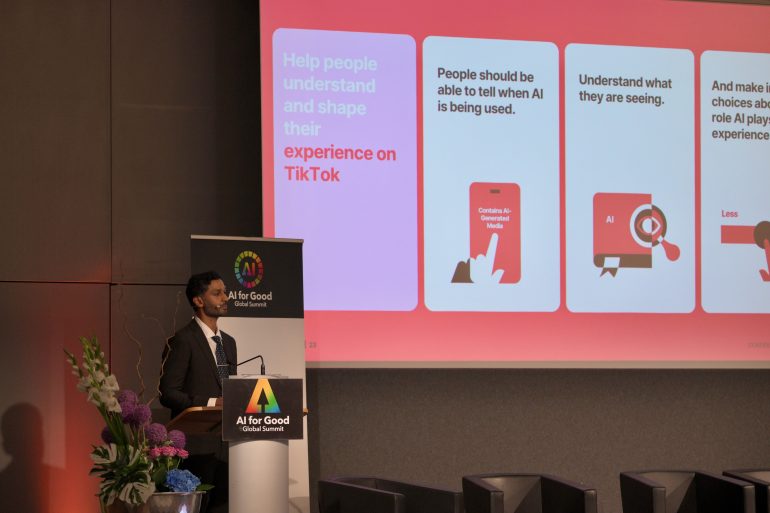
TikTok made a bundle of announcements at the AI for Good Global Summit in Geneva recently covering spam detection, content labelling and AI literacy. On paper it reads like housekeeping. It isn’t. Every major platform right now is racing to make AI generation faster and cheaper and harder to tell apart from something a person actually shot. TikTok spent this entire announcement on the opposite problem. Not how to make more content, but rather, how to prove which content is real.
The spam numbers alone should reframe how seriously anyone takes this. TikTok removed more than 86 million fake accounts globally in the first quarter of 2026. That’s not occasional enforcement. That’s an industrial-scale filtration system running continuously, because the alternative is a feed where genuine creators disappear under content nobody actually made, produced instead to game an algorithm at volume. TikTok is now testing detection systems aimed specifically at accounts dedicated to mass-producing AI spam, which is a narrower and harder problem than general fake-account removal. Ordinary spam detection catches accounts behaving suspiciously. This has to catch content engineered, on purpose, to look like nothing was mass produced at all.
The labelling numbers tell the same story from a different angle. More than three billion videos have now been tagged as AI-generated, using a mix of Content Credentials, creator disclosure tools and invisible watermarking technology. Three billion stops being a feature at some point and starts being infrastructure, built by a platform that has accepted AI video isn’t an edge case anymore. It’s a permanent, growing share of everything people upload. TikTok joining the C2PA Steering Committee, the body shaping how Content Credentials work industry-wide, fits the same logic. Platforms don’t usually volunteer for standards work unless they’ve already concluded the standard is coming whether they help write it or not.
None of this is altruism. Authenticity became a business problem for TikTok before it became an ethical one, and South African companies already know what happens when that problem isn’t caught early enough. We covered how AI voice fraud is hitting South African businesses with cloned executive voices convincing enough to nearly trigger fraudulent transfers, and the same underlying failure applies here. A feed that can’t tell a real creator from a synthetic lookalike stops being able to reward originality, and rewarding originality is the entire mechanism keeping people watching in the first place. Generation is cheap now. Verification is expensive. Expensive is where the advantage sits.
Which is also why the literacy side of this matters more than it looks like it should. TikTok has committed more than $4 million to its AI Literacy Fund since launching the programme in November 2025, working with the National Association for Media Literacy Education on a guide to help people use AI tools responsibly, and it’s now opening an in-app AI literacy hub for users in South Africa, Nigeria and Kenya. These happen to be three of TikTok’s fastest-growing markets, and three markets with the least existing infrastructure to catch AI-generated misinformation before it spreads. Locally, TikTok has been working with Moxi Africa on AI literacy content, alongside the Centre for Journalism Innovation and Development, Africa Check and Paradigm Initiative in Nigeria, and Eveminet and Mtoto News in Kenya. Those partnerships have racked up more than 200 million views between them. That number says less about TikTok’s marketing muscle and more about how badly these markets have been wanting a plain explanation of what they’re actually looking at.
AI safety tooling almost always arrives in Silicon Valley and Europe first, everywhere else treated as an afterthought rollout rather than something designed for from the start. Not this time. South Africa, Nigeria and Kenya are in the first wave here, not the second. Maybe that’s genuine strategic intent. Maybe it’s simply that these are three of the fastest-growing markets TikTok has anywhere. Either way the effect is the same on the ground. People coming online through TikTok as their first real entry point to the internet, not a secondary one, are getting AI literacy tools built into the product almost from day one, rather than bolted on years later once the damage is already sitting in someone’s feed. That’s not nothing in a country where data costs still dictate how people consume media, and where a short-form video app functions as a lot of people’s news source whether it was built for that or not.
The showcase of African AI creators folded into the same announcement isn’t just goodwill padding. TikTok is investing in tools like Smart Split and AI Outline at the same time as it builds detection against misuse of those same technologies, and creators like South Africa’s Akhil and Motso Mike, Kenya’s Tonnee Ndungu and Nyandia Gachago, and Nigeria’s Olayemi Afolabi and Comfort Obiagbaoso are the proof of what the upside actually looks like. Building the guardrails and building the creative tools aren’t pulling against each other. They’re the same bet made twice, once on the risk and once on the upside, because a platform that only did one or the other wouldn’t survive either version.
Every platform is going to have to make this same trade eventually, between how fast it can generate and how much people still believe what they’re seeing. Get that balance wrong first, and trust doesn’t come back on its own. No amount of AI-powered creative tooling buys it back once it’s gone.