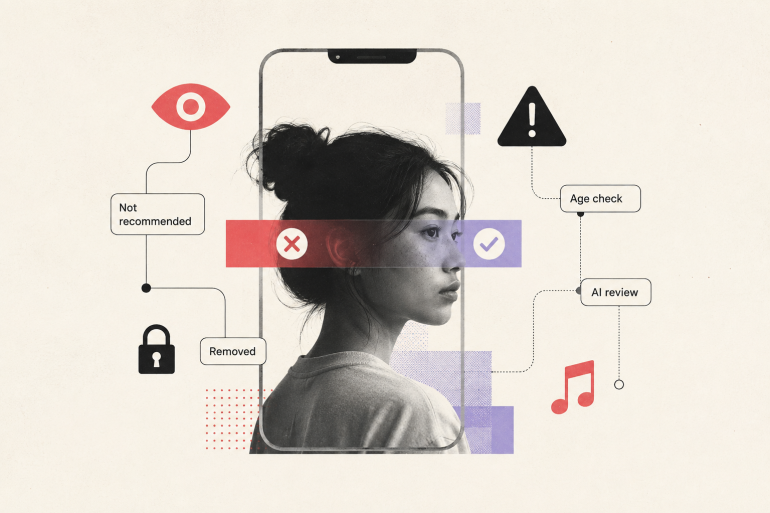
Spend enough time on TikTok and eventually something disappears. You send a video to a friend and, by the time they open it, there’s nothing there. You return to an old favourite and discover that the video survived but the song didn’t. A LIVE you were watching suddenly ends. Sometimes there’s an explanation, sometimes there’s a grey box, and usually there’s another video waiting underneath it, so you swipe and forget about the whole thing.
TikTok removed 1,192,526 videos in South Africa during the first three months of 2026. It also removed more than 346,000 accounts it suspected belonged to children under 13 and interrupted 141,565 South African LIVE rooms for violating its rules. Almost every local video it removed, 99.6%, was found before anyone reported it.
A million removals sounds enormous when presented in a transparency report. From inside TikTok, they arrive individually and mostly without ceremony. One video isn’t there anymore. One account vanishes. One livestream stops. One song falls silent.
Taylor Swift’s music recently started disappearing in exactly this way from a handful of particularly conspicuous TikToks.
Several <a href=”https://ew.com/taylor-swift-removes-multiple-songs-from-trump-social-media-posts-12037037/“>videos posted by Trump-affiliated accounts that had used Swift’s songs have been muted</a>. A Team Trump video paired “August” with footage of Donald and Melania Trump watching fireworks and joked that Swift would be “super excited” about the choice. Another Trump-related post used “Father Figure”. The videos remain online, but the songs don’t.
The internet quickly supplied the more satisfying version of events: Swift had forbidden Trump from using her music and TikTok had given artists a new way to decide which particular accounts could touch their catalogues. The public evidence doesn’t get us quite that far. Swift and her representatives haven’t explained precisely what happened, and TikTok hasn’t announced a feature that lets musicians simply type an account name into a box and revoke its access.
Still, something fairly remarkable is happening in plain sight. “August” remains available on TikTok. Millions of other people can keep putting Swift’s music beneath break-up stories, holiday montages, make-up tutorials, cats, weddings and whatever else the algorithm serves up this afternoon. The objection isn’t necessarily to the song being on TikTok. It’s to a particular relationship between the song and the person using it.
Two years ago, music rights on TikTok looked considerably blunter. When Universal Music Group and TikTok failed to agree on licensing terms in 2024, the consequences spilled across the platform. TikTok said it was removing songs written or co-written by songwriters represented by Universal Music Publishing Group. People opened videos they’d already made and discovered that the music had gone because two companies had stopped agreeing about who was entitled to play what.
The relationship was eventually repaired. TikTok and UMG have since gone further, announcing another multi-year global licensing agreement in May 2026. Yet the difference between that episode and the recent Swift-Trump videos is useful. The old dispute made songs unavailable because of who owned them. The newer dispute can leave the song untouched while questioning one particular use.
TikTok’s existing copyright process allows rights-holders to complain about specific content they believe infringes their work, although copyright is considerably less tidy than an online reporting form. A copyright owner doesn’t acquire an automatic legal right to suppress every use they dislike. Fair use, fair dealing and other exceptions exist, and TikTok acknowledges them in its own policy. Music used by businesses also has a different rights framework, which is why TikTok maintains a Commercial Music Library for tracks cleared for specified commercial uses.
Most TikTok users don’t need to know any of this. They only see that the sound is unavailable.
That distance between the complexity of the decision and the simplicity of what appears on our screens runs throughout TikTok’s latest Community Guidelines Enforcement Report. Globally, the company removed 184,012,576 videos between January and March, around 0.5% of everything uploaded. More than 178 million were detected and removed using automated technologies. Then 8,838,710 videos were reinstated after further review.
Nearly nine million second thoughts is an interesting companion to a 99.6% proactive-removal rate.
For anyone who’s posted regularly to social media, the experience isn’t especially exotic. Something inexplicable gets flagged. You appeal. Sometimes the content reappears, perhaps with a message that tells you very little about why it disappeared in the first place. The person uploading a video experiences one frustrating mistake; the platform experiences an error rate. These are two ways of describing the same event, and only one of them has to live with the consequences of the decision.
There probably isn’t a credible alternative in which every TikTok is watched by a person before the rest of us are allowed to see it. The amount of content is absurd, and the recommendation engine doesn’t politely wait for an editorial meeting before distributing it. We’ve run into a version of the same problem elsewhere, where human oversight starts to strain when automated systems can make decisions faster than humans can meaningfully inspect them.
The question TikTok now faces is stranger than whether a machine can recognise something that violates a rule. Increasingly, the platform needs the machine, or the larger system around it, to understand why something might violate a rule here but not there.
Consider age. Anyone who spent part of their childhood lying to websites about their birthday will understand the limitations of a box asking how old you are without needing them explained. TikTok says it removed more than 346,000 South African accounts in three months because it suspected they belonged to children under 13.
Those aren’t necessarily 346,000 individual children. They’re accounts TikTok suspected belonged to younger users, and people can create more than one account. The more interesting question is how a platform decides not to believe the birthday somebody gave it.
Once an age gate stops being trusted, age assurance begins to demand other information. Behaviour can reveal things. So can photographs, patterns of activity and additional verification. Governments and parents increasingly want technology companies to know when a child is pretending to be older, while many of the same societies are deeply uncomfortable with technology companies becoming better at inferring intimate facts about people who haven’t volunteered them.
Neither concern is silly. They just coexist badly.
The same discomfort appears in LIVE, although here the problem is time. TikTok interrupted 141,565 LIVE rooms in South Africa during Q1. Globally, it recorded more than 58 million enforcement actions, including warnings and demonetisation, against LIVE sessions and almost 22 million LIVE creators under its monetisation rules.
A prerecorded TikTok can be reviewed tomorrow. The LIVE you’re watching at 9:14 tonight is gone by 9:45. A moderation system that understands what happened after everybody has already watched it may be perfectly accurate and almost useless.
TikTok therefore needs speed, and speed pushes the first judgement towards machines. But some of the decisions we’re handing those systems are becoming less machine-like all the time.
TikTok says it removed 32,504 videos globally in Q1 under its rules for edited media and AI-generated content. It requires realistic AI material to be labelled in certain circumstances, uses automated detection alongside creator labels and supports C2PA Content Credentials, which can carry information about the origin and editing history of digital media. TikTok says more than three billion videos have now been labelled through its transparency efforts.
Whether something was made with AI is already becoming one of the least interesting things you can know about it. An AI-generated picture of Taylor Swift could be a joke, fan art, advertising, pornography, political propaganda or an illustration accompanying an article about AI-generated pictures of Taylor Swift. The technology used to make the image doesn’t answer the question of what the image is doing.
Swift has encountered the political version before. During the 2024 US presidential campaign, Trump shared AI-generated images that falsely suggested she had endorsed him. She later referred to those images when announcing her actual political endorsement and explaining her concern about AI-generated misinformation.
Two years later, her music is disappearing from Trump-affiliated TikToks.
The two incidents belong to different legal and policy worlds. One concerns synthetic media and political representation; the other concerns music rights. But place them beside each other and TikTok’s problem becomes easier to see. A photograph of Taylor Swift isn’t objectionable. A Taylor Swift song isn’t objectionable. An artificial image of Taylor Swift isn’t automatically objectionable either. What changes is the claim being made with it, the person making that claim and whether the person being represented or whose work is being used has any say in the matter.
The internet once allowed us to imagine content moderation as a sorting problem. Some things were allowed in the pile and some things weren’t. The difficult cases sat around the edges, where people argued about whether a nipple was art or pornography and whether a violent image was journalism or glorification.
TikTok increasingly has to make decisions where the exact same thing can belong on both sides of the line.
The same song can be allowed in one video and challenged in another. The same face can appear in a real photograph and in an invented political endorsement. The same person can be allowed to use TikTok at 13 and prohibited from using it at 12, while the platform has no direct access to the truth of their age. A LIVE can be ordinary until, in the space of a sentence, it isn’t.
These are questions about relationships as much as content: between a creator and a copyright owner, an image and the person it depicts, an account and the person behind it, a livestream and the moment in which it’s happening.
Humans aren’t particularly good at agreeing on many of these questions either. We argue about context constantly. Courts do it. Journalists do it. Parents do it. Copyright lawyers have made very successful careers out of it. TikTok is trying to make versions of those judgements millions of times over, quickly enough that most of us never notice a judgement was made.
Its transparency report offers no way to know how often that works. The numbers describe TikTok’s enforcement according to TikTok’s own rules, and a statistic about content successfully detected can’t reveal content the platform never realised it had missed. The almost nine million videos restored after review are at least a reminder that certainty often arrives after the first decision rather than before it.
For users, this vast governance system rarely feels vast. It’s compressed into tiny interruptions in otherwise ordinary afternoons. The song isn’t available. The account can’t be found. The LIVE has ended. The video your friend sent has vanished before you got around to watching it.
Then another TikTok starts playing.
That may be the strangest achievement of modern platform moderation: not that it happens on such an extraordinary scale, but that it can govern so much of what we’re permitted to see, hear and share while remaining almost invisible until one of its decisions touches something we care about.
Taylor Swift has the unusual ability to make one of those decisions visible. Her name turns a muted soundtrack into international news. Most people’s disputes with automated systems will never be nearly as legible. They’ll see a notification, appeal if the option exists and perhaps eventually get an answer.
TikTok made more than a million removal decisions involving South African videos in three months. We don’t experience a million decisions. We experience the one video we were looking for, and the small blank space where it used to be.