
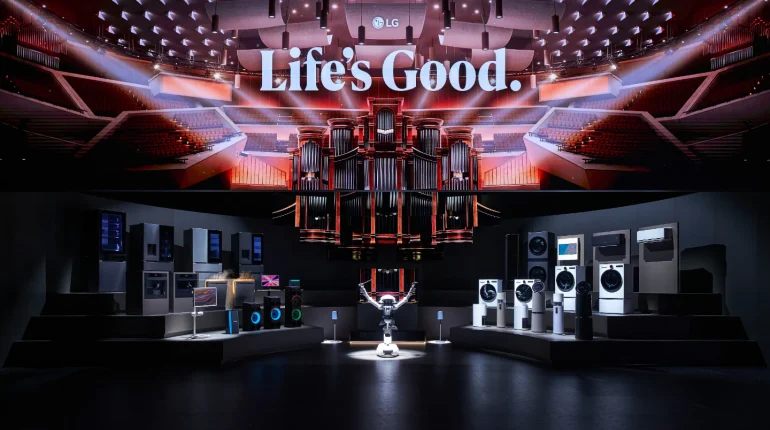
AI has found its way into almost every piece of consumer technology over the past few years, but the smart home remains one of the places where it could be genuinely useful while still being vastly underutilised. Nobody particularly needs a washing machine to write poetry, but having your home understand that you’re leaving for a week and adjust the appliances, lights and energy use accordingly makes rather more sense.
That’s broadly the argument LG is making at IFA 2026 in Berlin, where the company has expanded its AI Home ecosystem around ThinQ ON, its ThinQ platform and a new conversational AI agent called ThinQ Claw.
The idea is to move away from the fairly rigid smart-home systems we’ve become used to, where users manually build routines and tell individual devices what to do, towards something capable of understanding what’s happening around the person using it.
Whether people are ready to hand that much of their domestic life over to an AI system is another question, but LG at least has a clearer use for the technology than simply putting another chatbot inside an appliance.
ThinQ Claw wants to run the house
ThinQ Claw is making its public debut at IFA and works as a text-based AI agent connected to LG ThinQ ON.
Instead of navigating through menus or creating a collection of individual smart-home rules, users can communicate with it in natural language. The system can then use information about household conditions, preferences and routines to recommend or carry out relevant actions.
LG’s examples include preparing connected cooking appliances when someone is hosting guests, adjusting temperature and air quality before they arrive home, or recognising from a connected calendar that the household is going away and suggesting that lights, TVs and other devices be turned off.
More importantly, ThinQ Claw is designed to retain information about the user’s preferences over time. That brings LG closer to the version of the smart home companies have been promising for years: one where the system understands enough context to stop asking you to program every little thing yourself.
There’s an obvious privacy question whenever increasingly detailed information about routines, preferences and what happens inside a home becomes part of the equation. LG says its Shield security framework is applied across the AI Home ecosystem to protect connected products, services and customer data.
LG is opening the smart home beyond LG
One of the more interesting parts of LG’s approach is that the company isn’t restricting the whole system to appliances with an LG badge on them.
Its AI Home ecosystem incorporates Homey, the smart-home platform developed by Athom. LG acquired an 80% stake in Athom in 2024, giving it access to a much larger ecosystem of connected devices from other manufacturers.
At IFA, LG is demonstrating this through a Home Energy Management System that can coordinate things like smart meters, solar generation, home batteries and EV chargers alongside household appliances.
For markets where electricity prices change depending on the time of day, the system can also decide when it makes the most sense to generate, store or use energy. The broader point is that your washing machine and solar system shouldn’t need to live in separate digital worlds if they’re both consuming and managing the same household electricity.
LG is taking some of this technology outside the home too. ThinQ Pro, its centralised appliance and HVAC management platform for residential developments and commercial properties, is making its European debut at the show.
Smaller appliances without smaller capacity
AI may dominate the messaging, but some of LG’s more practical work at IFA has very little to do with a chatbot.
Its expanded Fit & Max range has been designed specifically around European homes, where kitchens and laundry areas are often considerably tighter than those found elsewhere.
The idea is fairly straightforward: make appliances that occupy less space without taking away useful internal capacity. LG first applied the approach to refrigerators but is now expanding it across washing machines, dryers and dishwashers.
The new dishwashers include models capable of completing a wash and dry cycle in around an hour, although LG notes that the actual time will vary according to conditions and any additional options selected.
Energy efficiency is getting similar attention. LG says one of the washing machines on display uses up to 70% less energy than the minimum requirement for an A rating under current European regulations, based on the Eco 40-60 programme.
The company is also moving some of the energy-saving technology previously reserved for its premium machines further down its appliance range.
That matters considerably more to most households than an appliance discovering another way to describe itself as intelligent.
LG has already been bringing some of its newer appliance thinking to South Africa too. The recently launched 38-litre SolarDOM combines microwave, oven, grill, steam and air-frying functions in one machine and connects to ThinQ for energy monitoring and diagnostics.
There’s still room for a spectacular television
The connected home is only part of LG’s enormous IFA stand.
The company is also showing its latest display technology, including the OLED evo AI range, Micro RGB evo AI and the OLED W6 Wallpaper TV.
We’ve already covered the W6, partly because it’s difficult to ignore a television that measures just 9.95mm thick.
The 77-inch and 83-inch models separate most of their AV connections from the television itself, using LG’s Zero Connect Box to transmit 4K video and audio wirelessly to the screen. You still need to plug the television into power, obviously, but the usual collection of HDMI cables can disappear into a cabinet elsewhere in the room.
LG is using a collection of W6 and other televisions at IFA to create a large media-gallery installation rather than showing each screen as an isolated product.
Its 2026 OLED evo AI and Micro RGB evo AI displays are also being demonstrated with LG’s Alpha 11 AI Processor 4K Gen3, with much of the company’s AI work here devoted to the rather more familiar jobs of picture and sound processing.
And then there’s a 1,000Hz monitor
Elsewhere on the stand is a product that barely needs an AI story attached to it.
LG’s UltraGear 25G590B is a 24.5-inch Full HD gaming monitor with a native 1,000Hz refresh rate.
Yes, one thousand.
The monitor is intended for competitive esports rather than someone playing Civilization on a Sunday afternoon, with the extremely high refresh rate aimed at reducing the time between something happening in a game and appearing on the display.
There are diminishing returns here for anyone without the hardware, games and reaction times capable of taking advantage of it, but reaching a native 1,000Hz remains a fairly ridiculous technical achievement.
It also provides a useful counterpoint to the rest of LG’s IFA messaging. While almost every major technology company is currently trying to explain how AI will change our homes, TVs and appliances, sometimes a new piece of technology is interesting simply because someone decided a monitor should refresh its entire image a thousand times every second.
LG’s bigger bet is that these two sides of consumer technology increasingly belong together. The company wants ThinQ to become the connective layer running through the appliances, entertainment devices, energy systems and eventually robots around the home.
The real test won’t be whether LG can connect all of those things. We already know that it can. It’ll be whether the resulting home becomes noticeably easier to live in once it does.