
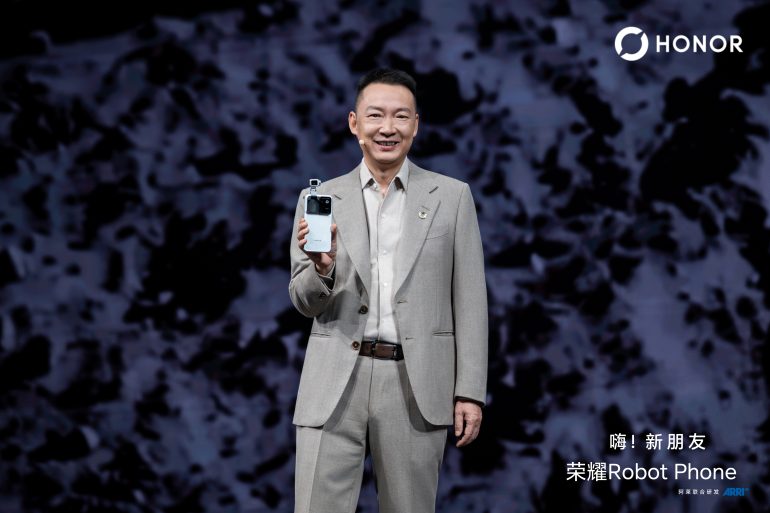
The HONOR Robot Phone arrives at an unexpectedly good moment for a smartphone with a camera that physically climbs out of its body. Samsung has just discovered that its unusually wide Galaxy Z Fold8 can attract buyers in numbers large enough to disrupt its own production assumptions, while HONOR is now asking a more difficult version of the same question: how strange can a phone become before novelty stops helping and starts getting in the way?
HONOR launched the Robot Phone in China on 12 August after first showing the idea at MWC earlier this year. The finished device uses a three-axis mechanical gimbal with four degrees of movement, allowing the camera to tilt, pan and reposition itself independently of the handset. The mechanism contains more than 100 precision components, while its tiny 2.6g gimbal motor can move at up to 360 degrees per second. South China Morning Post describes a camera capable of nodding back at its owner, which sounds faintly absurd until you watch what HONOR is actually trying to make it do.
The phone can follow someone moving through a room, adjust its framing during a video call, respond to gestures and orient itself towards whoever is speaking. HONOR calls this embodied AI, although the label is less useful than the behaviour itself: instead of AI remaining another layer of software sitting behind the display, it can make a physical part of the phone move in response to what is happening around it.
That changes HONOR’s Robot Phone from a camera-phone oddity into a more interesting test of where smartphone hardware might go next.
Samsung has already made one risky shape look sensible
The Galaxy Z Fold8 offers a useful comparison because Samsung has just taken a risk with a category it has spent years making familiar. Rather than refining the tall, narrow shape of previous Folds, the standard Fold8 is shorter and considerably wider. It looks different enough that the design becomes part of the buying decision rather than something you stop noticing after reading the spec sheet.
Early demand suggests that difference has helped rather than hurt. Samsung’s latest foldables have posted strong pre-order numbers in South Korea, with the standard Fold8 attracting particular interest and forcing the company to rethink production allocations. That response is notable because Samsung also sells the more familiar Fold8 Ultra, yet plenty of buyers appear drawn to the model that departs more obviously from what came before.
There’s a practical reason for that. A wider outer display makes the Fold8 more useful while it’s closed, particularly for video, browsing and everyday phone tasks, while the larger inner screen still gives buyers the productivity and multitasking advantages that justify carrying a foldable in the first place. The unusual shape isn’t decoration. It changes what the device is good at.
That relationship between form and behaviour has already started appearing elsewhere in smartphones. In The smartphone is dead. The AI computer is replacing it, the argument was that phones are beginning to be designed around software that can juggle more information, more states and more tasks at once. A wider foldable suddenly makes more sense when the device is expected to behave less like a collection of individual apps and more like a small computer coordinating things across them.
HONOR is approaching the same problem from a completely different direction. Instead of changing the screen around the software, it has given the software something physical to control.
The camera arm has to earn its place
The Robot Phone’s gimbal isn’t merely there to stabilise video. HONOR’s YOYO Robot Mode combines subject tracking, gesture recognition, contextual awareness and voice-source localisation so that the camera can move without someone physically steering it. It can follow a person during a vlog, rotate towards whoever is speaking on a call or deploy itself when the user makes the appropriate gesture. The camera also supports modes including Tilt Lock, FPV, FPV Vertical and AI SpinShot.
Those abilities make the strongest case for the hardware. A creator filming alone normally has to decide where the camera should point before stepping into frame, use a separate tracking gimbal or accept that they’ll wander out of shot. HONOR is building that movement into the phone itself.
When HONOR first showed the concept, I argued that the HONOR Robot Phone said more about AI than it did about robots. The mechanical camera was eye-catching, but the more useful idea was that an AI system might eventually act through the hardware around it rather than simply responding inside an app. The commercial device now has to prove that this idea survives contact with actual users.
The Verge spent around an hour testing the Robot Phone and came away more impressed than the premise suggested, particularly by how competently the gimbal tracked movement and repositioned itself. CNET has also focused on the way HONOR is merging conventional smartphone imaging with a physically moving camera system, while GadgetMatch places the commercial launch in the context of the concept device shown at MWC earlier this year.
There are obvious reasons for scepticism. Smartphones get dropped, squeezed into pockets with keys, covered in dust and used for years by people who will never treat a mechanical camera assembly as delicately as a prototype deserves. Motors and moving joints introduce possible failure points that a sealed camera module avoids, and HONOR hasn’t yet had enough time in the market to prove how this mechanism ages.
The gimbal therefore has two jobs. It has to survive normal ownership, and it has to be useful often enough that owners don’t begin wishing HONOR had simply given them a thinner phone.
HONOR hasn’t skimped on the cameras around it
The rest of the imaging system gives the Robot Phone a better chance of being taken seriously. Its main gimbal camera uses a 200MP sensor measuring 1/1.28 inches with an f/1.6 aperture. A second 200MP periscope camera uses a 1/1.4-inch sensor and offers 2.7x optical zoom, while a 50MP ultra-wide camera covers a 122-degree field of view.
HONOR has also partnered with ARRI, which is more interesting than the usual celebrity photographer endorsement or collection of branded colour filters. The main camera can record 10-bit ARRI LogC3 in ARRI CINEMA mode, while the processing pipeline incorporates ARRI Wide Gamut 3 and ARRI Looks. HONOR says image data is processed internally at 14-bit 4:4:4 before being output as 10-bit LogC3 and 4:2:2 video, giving creators footage that can move into software such as DaVinci Resolve and established ARRI LUT workflows.
A phone using professional cinema terminology still isn’t a cinema camera, and HONOR isn’t going to change that with a logo in the menu. The more persuasive part of the partnership is how it fits the rest of the product. A camera that can physically follow you becomes more useful if the footage it produces is also flexible enough for people who care about colour grading and post-production.
The HONOR Robot Phone is therefore aimed at a fairly specific kind of buyer. Someone who regularly records themselves, livestreams, shoots social video or works alone can see the appeal immediately. For everybody else, the mechanical arm may spend a lot of time folded away.
That limitation could be fine. Not every expensive phone needs to make sense for everybody.
The rest of the hardware leaves little room for excuses
HONOR has built the Robot Phone around flagship specifications rather than treating it as an experimental side project. It uses Qualcomm’s Snapdragon 8 Elite Gen 5 platform, has a 7,060mAh silicon-carbon battery and supports 120W wired charging and 50W wireless charging. The display is a 6.31-inch LTPO OLED panel with an adaptive 1Hz to 120Hz refresh rate and a claimed peak brightness of 6,800 nits.
That battery is particularly characteristic of HONOR’s recent approach to premium phones. The company has been much more aggressive than Samsung and Apple in adopting silicon-carbon battery technology, allowing it to increase capacity without turning every flagship into a brick. The HONOR Magic8 Pro used a 7,100mAh battery and showed that the number could translate into a meaningful everyday advantage rather than another specification designed for a launch slide.
The Robot Phone takes that familiar HONOR strength and attaches a far less familiar reason to buy the device. Battery endurance is easy to understand. A camera that physically turns towards you while you’re speaking takes longer to place in your life.
The Fold8 comparison only goes so far
Samsung has the easier problem. Foldables are no longer mysterious, and the Fold8 changes the proportions of something buyers already understand. Its wider shape can be explained by showing somebody Netflix on the outside screen or a spreadsheet on the inside one.
HONOR is trying to establish a new behaviour. Smartphone users are already accustomed to software tracking faces and stabilising footage, so the Robot Phone has to demonstrate why a camera should physically move as well. The answer will probably depend less on image quality than on whether people discover situations where the phone can replace another piece of equipment or another person.
That makes creators an obvious starting point, but it also raises the possibility that the feature finds uses HONOR didn’t design around. A phone that can orient itself could make video calls less awkward, keep children in frame while they move around, follow someone demonstrating a recipe or let a family capture moments without leaving one person behind the camera. None of those uses requires cinematic ambitions.
The risk is that consumers look at exactly the same hardware and see something else: cost, complexity and a part waiting to break.
Samsung’s Fold8 has already had years of foldable development behind it, and its unconventional shape still sits inside a category that people know how to evaluate. HONOR is starting much closer to zero.
It starts at RMB 9,999 in China
The Robot Phone will initially be sold in China in two configurations. The 12GB RAM and 512GB storage model costs RMB 9,999, while the 16GB RAM and 1TB version costs RMB 12,999. Pre-orders opened on 12 August and sales begin on 18 August. South China Morning Post puts the starting price at roughly US$1,482.
HONOR hasn’t announced South African pricing or availability, so there’s nothing yet to suggest local buyers will be able to walk into a store and buy one. A South African release wouldn’t be unimaginable, though. HONOR has spent the past few years pushing much harder into the local premium market, including with the Magic8 Pro, rather than restricting itself to the more affordable phones on which it built much of its earlier presence.
The Robot Phone would test that progress in a different way. Selling another good flagship is one thing. Asking somebody to spend flagship money on a phone whose defining feature has no established category around it is a considerably harder proposition.
That may also be why China makes sense as the first market. HONOR gets to discover whether people are willing to pay for the idea before deciding how widely it should travel.
Smartphones have become predictable at exactly the wrong time
The irony of the current smartphone market is that the software is becoming less predictable while the hardware has become remarkably conservative. AI agents are being asked to perform tasks across apps, camera systems can reconstruct scenes computationally and phones increasingly behave like computers rather than static collections of tools, yet most flagships still look almost interchangeable when their screens are switched off.
Samsung’s Fold8 and HONOR’s Robot Phone approach that mismatch from opposite directions. Samsung has altered the shape of the device to make familiar behaviour work better. HONOR has put a movable piece of hardware under the control of the software.
Neither approach guarantees a hit, and the Robot Phone in particular could still end up being remembered as one of those devices people loved seeing in videos but didn’t actually buy. The history of smartphones is full of clever mechanisms that disappeared once manufacturers worked out that consumers admired them more than they used them.
The Fold8’s early response gives HONOR one reason to be optimistic, though. Buyers don’t appear to require every premium phone to look like the one they already own. They’ll tolerate unusual hardware when they can understand what they get in return.
HONOR now has to find out whether a camera that follows you around the room clears that bar.