
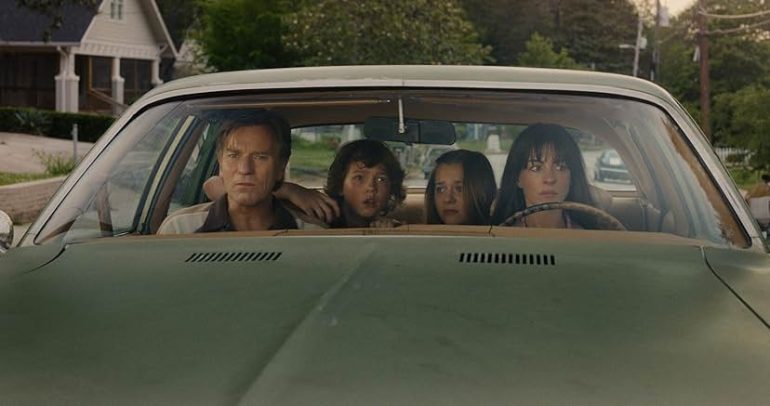
There’s a point early in The End of Oak Street where you realise this could’ve gone horribly wrong. Anne Hathaway and Ewan McGregor are playing stressed suburban parents, their neighbourhood has been ripped out of ordinary reality by a mysterious cosmic event, and there are dinosaurs involved. It sounds like the sort of pitch that could very easily become two hours of people shouting while expensive CGI crashes through houses. Somehow, it isn’t.
David Robert Mitchell’s film is a strange mix of family drama, creature feature and old-fashioned summer adventure, and while those parts don’t always fit together cleanly, I had a much better time with it than I expected to.
Set in 1982, the film follows Denise and Greg Platt, played by Hathaway and McGregor, and their children Audrey and Brian, played by Maisy Stella and Christian Convery. Their suburban neighbourhood, Oak Street, is suddenly transported somewhere unknown, leaving the family and everyone around them trying to work out what’s happened and, more urgently, how to stay alive. That’s about as much as I’d want to know going in. The official The End of Oak Street websitekeeps the premise similarly vague, and the movie is better when some of what follows is allowed to surprise you. Mitchell wrote and directed the film, with J.J. Abrams, Hannah Minghella, Jon Cohen, Mitchell, Matt Jackson and Tommy Harper producing.
The dinosaurs are obviously the main attraction, and yes, they’re good. More importantly, the film doesn’t treat their arrival like it’s unveiling a new ride at a theme park. Mitchell lets them be dangerous, unpredictable animals that happen to have wandered into a place designed around lawns, family cars and swimming pools.
There’s something inherently funny about that contrast too. A dinosaur moving between suburban houses looks ridiculous until it suddenly doesn’t. The surroundings make the animals feel bigger, but they also make the people around them look hopelessly underprepared. It turns out a wooden fence isn’t much of a defence against prehistory.
The film has fun with that without becoming a comedy. There are jokes, some very good ones, but most come from people reacting badly to an impossible situation rather than characters constantly trying to be funny. That restraint helps because The End of Oak Street can turn nasty when it wants to, and the film works best when you’re not entirely sure which version of it you’re about to get.
Hathaway and McGregor also stop the family story from becoming something you simply tolerate between dinosaur attacks.
Denise and Greg are already having problems before Oak Street disappears, and their marriage feels convincingly tired. Not catastrophically broken, not waiting for one enormous speech to fix everything, just worn down by things they’ve clearly been carrying for a while.
McGregor is especially good at playing Greg as a man who’d really like everyone to believe he has things under control. He doesn’t. Sometimes you suspect he knows that. Sometimes you suspect he doesn’t.
Hathaway’s Denise is sharper, more practical and visibly exhausted by parts of the life she’s living, but the film doesn’t make her the sensible wife whose only purpose is to tell her husband he’s being an idiot. She has her own frustration and her own blind spots. Hathaway doesn’t overplay any of it, which makes the character much easier to believe.
It’s also an amusing change of scenery after watching her return as Andy Sachs in The Devil Wears Prada 2. One film has her dealing with the collapse of legacy media and Miranda Priestly. The other has dinosaurs. I’m not entirely convinced which is the more stressful environment.
Maisy Stella is probably the person I wanted more of. She has the same natural quality that made her so good in My Old Ass, and Audrey never feels like a teenager written by somebody trying very hard to remember how teenagers speak. Christian Convery’s Brian gets less room to make the same impression, although the four actors are believable enough together that the Platts feel like a family before the film asks you to care whether they survive as one.
Not everything works.
The 1980s setting means the Spielberg influence starts creeping in almost immediately, and sometimes it doesn’t creep so much as kick the front door down. There are suburban streets, bicycles, troubled families, kids facing something impossible and a Michael Giacchino score that occasionally seems determined to remind you exactly what sort of films Mitchell grew up watching. Some of that affection is charming. Some of it gets a little exhausting.
You can admire E.T., Poltergeist and Jurassic Park without wanting to spend an entire film being reminded that the director admires them too. The End of Oak Street is at its most interesting when Mitchell’s own stranger instincts begin to interfere with the nostalgia.
He is, after all, the director of It Follows. There are moments here where the atmosphere changes and the film becomes less cosy, less predictable and considerably more unnerving. Mitchell can make an ordinary space feel wrong without doing very much to it, and a suburban street turns out to be an excellent place for him to indulge that ability. I kept wishing he’d indulge it more.
There are points where The End of Oak Street feels as though it’s about to become a genuinely peculiar science-fiction film and then remembers that it’s also supposed to be a big studio movie about a family running away from dinosaurs. The shift back isn’t always graceful.
The pacing suffers from that indecision as well. The film can be exciting, then oddly leisurely, then suddenly frantic again. Some of the quieter family material works because Hathaway and McGregor are good enough to carry it. Other scenes feel like they’re keeping the dinosaurs outside until the screenplay is ready for them again. And yes, people make some extremely questionable decisions.
There’s always a certain amount of stupidity you have to accept in a survival movie. Sensible people doing sensible things for two hours generally isn’t much of a plot. The End of Oak Street occasionally pushes that arrangement a little far, and there were a few moments where my concern for somebody’s survival briefly became concern about their basic reasoning skills. It didn’t ruin the film for me, though.
Part of why The End of Oak Street works is that it doesn’t seem embarrassed by what it is. It’s a movie about a suburban family trying not to be eaten by dinosaurs. There’s some marriage trouble, some science-fiction weirdness and a lot of affection for the movies Mitchell clearly grew up with, but nobody appears to have decided that the premise needs to be apologised for. There’s something refreshing about that.
We’ve had decades of dinosaur movies since Jurassic Park, many of them literally part of the Jurassic Park franchise, and they’ve often become so weighed down by mythology and spectacle that seeing a dinosaur stopped being especially exciting. The End of Oak Street gets some of that excitement back simply by putting them somewhere different and surrounding them with characters who aren’t professional dinosaur handlers, geneticists or people who inexplicably keep returning to dinosaur islands. They’re just people who’d really rather not be there.
That doesn’t make The End of Oak Street some radical reinvention of the dinosaur movie. It isn’t. The influences are obvious, parts of it drag and there’s a weirder film inside it that I probably would’ve liked even more.
But I laughed more than I expected to, I cared about the Platts more than I expected to, and there were enough properly tense moments that the dinosaurs never became background decoration.
For a movie that begins with Anne Hathaway, Ewan McGregor, suburbia and dinosaurs, that’s more than enough.