
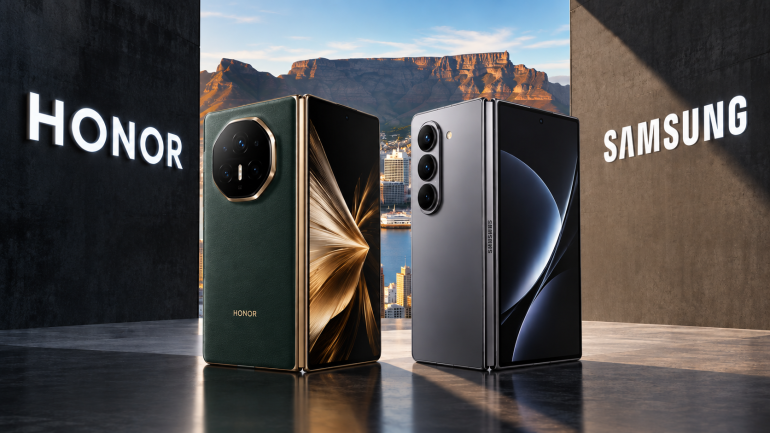
HONOR has had a very good few years in South Africa. At a recent media roundtable, South Africa CEO Fred Zhou said the company remains the country’s number two smartphone brand, behind Samsung. That’s quite a change from 2021, when the brand returned to the local market as an independent company following its split from Huawei.
The number two claim refers to devices shipped into South Africa rather than retail sales or revenue, but the growth hasn’t exactly been difficult to spot. Counterpoint Research ranked HONOR second for South African smartphone shipments in 2023, up from 1 percent share in 2022 to 13 percent for the full year. In the fourth quarter, the Chinese tech brand briefly moved ahead of Samsung with 24 percent of shipments, helped by the Magic4 Lite 5G and X6.
Earlier this year, Zhou told Business Day that the company had passed one million smartphones sold in South Africa and that its local business grew 66 percent during 2025. The same report noted that the brand has been making a deliberate push into phones priced above $300, after building much of its local scale further down the market.
That lower end of the range has been important. The X-series phones in particular have been very good at offering large batteries, decent displays and plenty of storage without asking people to spend flagship money. When you’re comparing devices on an operator’s website or standing in a store looking at monthly contract prices, that’s an easy proposition to understand.
The Magic V6 asks for R39 999. It’s a lot of money for any smartphone, but Samsung’s new foldable range makes the price more interesting than it first appears.
The regular Galaxy Z Fold8 starts at R40 999, only R1 000 more than the V6, although it isn’t really the closest Samsung equivalent. Samsung has turned the regular Fold into a wider, more compact foldable with a 5.5-inch cover display and a 7.6-inch screen inside.
The Galaxy Z Fold8 Ultra is much closer to what HONOR is selling. Its 6.5-inch cover display opens to an 8-inch screen, compared with 6.52 inches and 7.95 inches on the Magic V6. Samsung’s Ultra also starts at R50 999 for 512GB, making the V6 R11 000 cheaper than the Samsung foldable it most directly competes with.
If price is doing most of the work in your decision, that makes things considerably easier for HONOR. At R39 999, the Magic V6 still has a 6 660mAh silicon-carbon battery, weighs 219g and measures 8.75mm when folded. There’s also a 64MP periscope telephoto camera, IP68 and IP69 dust and water resistance, and the company says the hinge has been tested for 500 000 folds.
The battery is probably the first number I’d notice. Samsung’s Fold8 Ultra has a 5 000mAh battery, so the V6 manages to fit another 1 660mAh into a similarly sized phone. Silicon-carbon batteries have become one of the more useful smartphone developments of the past few years because manufacturers can increase capacity without making devices proportionally thicker and heavier. The Chinese brand has made particularly good use of the technology.
I don’t think the Magic V6 has much to prove when it comes to specifications. HONOR has been making very good flagship phones for a while now and, on paper, there are areas where the V6 comfortably beats Samsung’s much more expensive Fold8 Ultra. The difficult part starts when you stop comparing the two phones on a product page.
Selling a R40 000 phone is different
Someone buying a more affordable HONOR can compare it with another device at the same price without too much fuss. Battery life, storage, display quality, cameras and monthly contract cost will get you most of the way there. At the premium end, there’s a good chance you’ve already spent years using products from another brand.
A Samsung customer could own a Galaxy Watch and Galaxy Buds, have a tablet at home, use SmartThings, or have years of photos and backups sitting in a Samsung account. They’ve probably used Smart Switch before and already know their way around One UI. If something breaks, they’re also dealing with a company that has been selling smartphones in South Africa for decades.
HONOR hasn’t had anything like that amount of time. It only became independent in late 2020 and returned to South Africa the following year. The company has managed to build a sizeable smartphone business remarkably quickly, but getting someone familiar with the name is different from getting them to spend R39 999 on one of its phones.
The South African launch gives some idea of how the brand wants the V6 to be seen. Temba Bavuma, Ronwen Williams, Akani Simbine and Connie Ferguson are among the local names attached to it, alongside other ambassadors from sport, entertainment and business. Celebrity endorsements are hardly new in the smartphone world, but they make sense for a company that became popular here selling much cheaper devices and now wants to be considered alongside Samsung and Apple when people start spending serious money.
The company is also trying to make an expensive foldable a little less stressful to own. Magic V6 buyers in South Africa get 365 days of HONOR Care screen protection, covering one qualifying accidental-damage claim and including both screens if they’re damaged in the same incident. Screen parts and labour are included, and the brand also offers free round-trip shipping for postal repairs.
Foldables are much tougher than they were a few years ago, but I still wouldn’t want to find out what replacing an 8-inch folding display costs after dropping a R39 999 phone. Software support is another area where I’d like the company to be clearer locally. HONOR announced seven years of Android OS and security updates for its flagship Magic series in 2025, but said the programme would begin in EU markets. Its South African security bulletin lists the Magic V6 for monthly security updates, but that still isn’t the same as a clear seven-year local commitment. At this price, buyers shouldn’t have to go looking for that answer.
Samsung has had a long head start
The roundtable wasn’t only about smartphones. Zhou also spent time talking about the wider business and the company’s plans to build more around the devices it already sells. The Alpha Plan, announced at Mobile World Congress in 2025, comes with a promised investment of more than $10 billion over five years as the company tries to turn itself into what it calls an “AI device ecosystem company”.
There are already laptops, tablets and wearables, and then there’s the much stranger Robot Phone. The concept appeared in Johannesburg again, although you still can’t walk into a store and buy one. I’ve written about the Robot Phone before, and I still find what it says about the company’s thinking more interesting than the device itself.
The products people can actually buy are more important to what the brand is trying to do here. Someone considering a Magic V6 may already have a Windows laptop from another manufacturer, an iPad at home or a pair of AirPods they bought years ago. HONOR has been making its devices work more easily with products from other companies, including Apple hardware, which is far more useful than expecting somebody to replace everything they already own.
AI is a less convincing reason to choose one smartphone brand over another at the moment. Samsung, Apple, Google and pretty much everyone else are talking about image editing, transcription, translation and assistants, while many of the underlying services come from the same handful of technology companies anyway. The differences are much easier to understand when they’re physical: battery capacity, weight, thickness, camera hardware and price.
That has worked very well for HONOR in South Africa, but the company has been open about wanting more. Zhou has said the aim is to become South Africa’s number one smartphone brand by 2028. Moving further into premium phones is clearly part of getting there, because Samsung competes almost everywhere. Its range starts with relatively affordable Galaxy A-series devices and stretches past R50 000 for the Fold8 Ultra, with watches, tablets, TVs, monitors and home appliances carrying the same brand.
Samsung also has decades of local familiarity, long-standing relationships with operators and retailers, and the kind of marketing budget that keeps Galaxy visible even when you aren’t shopping for a phone. Globally, it has spent years becoming the company most people associate with Android. For plenty of consumers, especially those who don’t follow every launch, Samsung is simply the Android brand they know.
The Magic V6 gives the Chinese company a strong product to put up against all of that. It costs R11 000 less than the Fold8 Ultra, has a substantially larger battery and, in a few areas, is technically the more impressive phone. Some buyers will choose it for exactly those reasons, and that matters if the company wants a bigger share of the premium market.
Catching Samsung is a different job. There are Galaxy Watches on wrists, Samsung TVs in living rooms and years of backups sitting in Samsung accounts. HONOR has made up an extraordinary amount of ground in South Africa in a short period of time. Samsung has had decades to build the things that are harder to see on a specification sheet.