
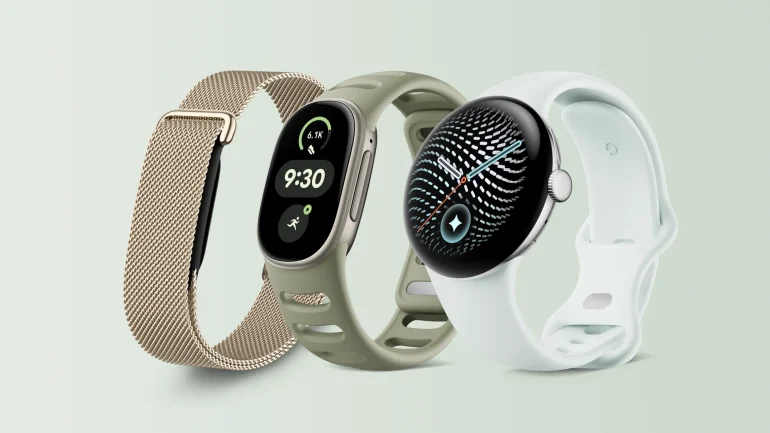
The Fitbit Edge is Google’s newest fitness tracker, and it brings a display back to a product category that has spent the year being praised for losing one. Google announced it on 12 October at US$179.99, with stock reaching shelves on 27 October and three months of Google Health Premium included with purchase.
There’s no confirmation that the Edge will come to South Africa, where Google pulled Fitbit in November 2023. The Fitbit Air does have a local route planned through Discovery, and that raises a question about the Coach that Google’s software list doesn’t answer.
What Google built
Google positions the Edge between the Pixel Watch and the Fitbit Air. The band has a Hybrid OLED screen that Google says offers 46% more viewing area than its earlier trackers, in a case 11.5mm thin that it claims is 45% lighter than the Apple Watch Series 12. Battery life is rated at up to seven days, and five minutes on the magnetic charger is meant to deliver a full day. Google also calls it the first repairable Fitbit tracker, thanks to a replaceable battery.
On the fitness side, there’s built-in GPS that Google says is up to 40% more accurate than previous generations, an altimeter, more than 50 exercise modes and automatic recognition of up to 100 workouts. A redesigned physical side button handles things like pausing a workout. The health side adds an ECG app and a skin temperature sensor, along with Health Guardian trend tracking for blood pressure and insulin resistance. Google’s own footnotes say some of those features aren’t available in every country.
The screen is the whole question
Google launched the Fitbit Air in May at US$99.99, and its appeal comes from what it leaves out. There’s no display, the only feedback is a small vibration motor, and everything lives in the Google Health app.
There’s a growing sense that a wrist display mostly exists to pull you out of whatever you’re doing, whether that’s a conversation at the dinner table or an hour you meant to spend offline. A band without a screen removes the temptation entirely and appeals to anyone suffering from screen fatigue.
Seen against that, the Edge’s feature list reads differently. Google lists call and message notifications, media controls and Google Maps among the things it does, on a screen it’s proudly calling its largest and brightest tracker display yet. Whether those can be pared back to near silence is something only testing will settle.
For anyone who trains with purpose, the Edge makes a stronger case than the Air. Seeing pace targets, heart rate zones and splits mid-workout is something a screenless band can’t do by definition, and the Edge’s built-in GPS means the phone can stay at home. That’s what the extra US$80 buys. Someone who bought an Air precisely to look at their wrist less will find the display is the thing they were avoiding. The Air suits people who want a wearable to disappear, and the Edge suits those who want some feedback without committing to a full smartwatch. The Edge is the more capable device, and how compelling it is depends on how much of the Air’s appeal came from the missing screen.
South Africa and the Fitbit question
South African buyers have a more basic problem, because Google doesn’t sell Fitbit hardware here. In November 2023, Google said that it was withdrawing Fitbit and Nest products from select countries to bring its hardware range closer to where Pixel is sold. Pixel has never been officially launched in South Africa. Google said existing owners would keep receiving support, warranty service and software updates.
Discovery has kept existing owners in the loop. Vitality members can still link a Fitbit and earn up to 300 points a day, and Discovery’s page notes that a Fitbit bought in another country works too.
The Air is now coming back through Discovery. In its 2027 announcements, Discovery said it plans to introduce the Fitbit Air in South Africa in 2027 through a collaboration with Google Health, available first to Discovery clients, with funding and rewards handled through Discovery Bank. Discovery’s release says further details are still to come.
Neither Google’s announcement nor Discovery’s mentions the Edge, so there’s no sign yet that it’s headed here. For now, an Edge would have to be imported, and whether Discovery’s list of Vitality-compatible Fitbit models will include it hasn’t been confirmed.
The Coach doesn’t live here
The more interesting puzzle is software. Google designed the Air around its Gemini-based Google Health Coach, and Google’s help page lists 37 countries where the Coach and Premium coaching features are available. South Africa isn’t on it, and neither is any other African country. Google’s launch post described the rollout as global, so the help page is the better guide to where it works.
The Air doesn’t need the Coach to function. Core tracking works without a subscription, so a South African Air could still record steps, sleep and workouts in the Google Health app. The Coach is what Google built the hardware to feed, though, and Discovery hasn’t said whether it’ll be part of the local offer.
Oura is the precedent. Discovery signed an exclusive partnership in October 2025 to bring the Oura Ring to Vitality members with a qualifying Discovery Bank account, making Discovery is the only official way to buy the ring in South Africa. The package includes the subscription that makes the ring actually useful, with Oura’s own partnership page listing a fully funded ring and a two-year Oura Membership for qualifying members. Discovery has already shown it can bundle a wearable with the service behind it.
Could it do the same for the Coach? It would follow a recognisable pattern, but nothing published says it will. It would need Google to make Premium available in South Africa, directly or through Discovery, and Google hasn’t announced either. Discovery has said its Personal Health Pathways changes draw on its partnership with Google, which suggests the two already work together on health software, although the announcement doesn’t say whether the Coach is involved.
Why the Edge matters
The Edge revives a product Google had let lapse, the capable fitness band. The last Fitbit tracker in that mould was the Charge 6 in 2023, the same year Fitbit left 29 countries, South Africa being them. The Edge offers meaningful health tracking, a screen and a week of battery life without moving up to a Pixel Watch. Its toughest competition may be Google’s own Air, which makes a rather persuasive case that the best wearable is the one that asks for the least of your attention.