

Everyone knows the feeling: your package is out for delivery, and suddenly your day isn’t yours anymore. You cancel plans, hover near your phone, time lunch breaks around the possibility of a knock at the door. It’s a small surrender we’ve all learned to make in exchange for convenience — the illusion of efficiency that still somehow costs us an entire afternoon.
Amazon‘s new delivery time slots are designed to dissolve that frustration. Customers in Johannesburg, Pretoria, and Cape Town can now choose when their orders arrive — morning, afternoon, or evening — and even schedule the delivery a day ahead. On paper, it’s a simple fix. In practice, it rewires one of the oldest imbalances in online shopping: who controls the waiting.
The idea is deceptively modest — not faster, just certain. South Africans have learned to live with time that shifts and stutters: power cuts, broken traffic lights, the long pause between “now” and “eventually.” Against that backdrop, knowing exactly when your doorbell will ring feels almost utopian.
Robert Koen, Amazon’s Managing Director for Sub-Saharan Africa, says the update reflects “local needs.” Maybe it does. But it also speaks to something more universal: the quiet relief of not having your day held hostage by an invisible system. Pick your window, reclaim your time — at least that’s how it feels. That’s how persuasion works when it’s built into the interface.
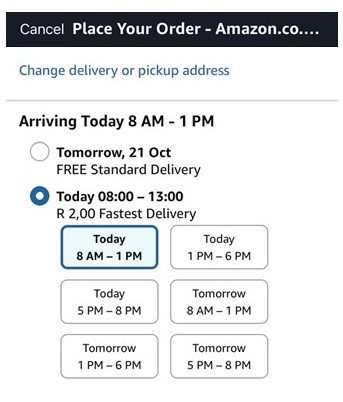
Each scheduled delivery comes with a small R2 fee — too little to object to, just enough to feel deliberate. You’re not paying for speed; you’re paying to make time predictable. That’s the clever part. When a brand turns scheduling into a service, it’s not selling efficiency. It’s selling calm.
Amazon’s whole model runs on this kind of calibration. Free shipping reshaped how we think about urgency. Prime turned loyalty into routine. Amazon’s delivery time slots make waiting itself feel optional — even though it’s just been renamed.
Convenience has become a kind of choreography — one we perform almost unconsciously. Every click, every tracking update, every push notification teaches us how to move in sync with the system. Delivery scheduling is simply the newest step.
For many South Africans still negotiating the limits of online retail, it’s an easy sell. A feature like this doesn’t just smooth over frustration; it redefines it as a choice. You’re not waiting — you’re planning. You’re not being managed — you’re participating. It’s choreography disguised as control, and we’ve all learned the steps.
TTakealot built reach. Checkers Sixty60 built speed. Woolworths built polish. Amazon is building predictability — a subtler kind of power that seeps into how we structure our days. It echoes a broader pattern across South Africa’s tech ecosystem: progress often depends less on invention and more on trust. You can see that dynamic in our piece on NOVAR’s IBM-backed journey, where the promise of advancement sits in tension with the quiet realities of dependence.
That’s why Amazon South Africa’s delivery time slots matter more than they seem. They don’t just make delivery more efficient; they reshape the psychological contract between shopper and system. Convenience used to mean saving time. Now it means being able to account for it.