
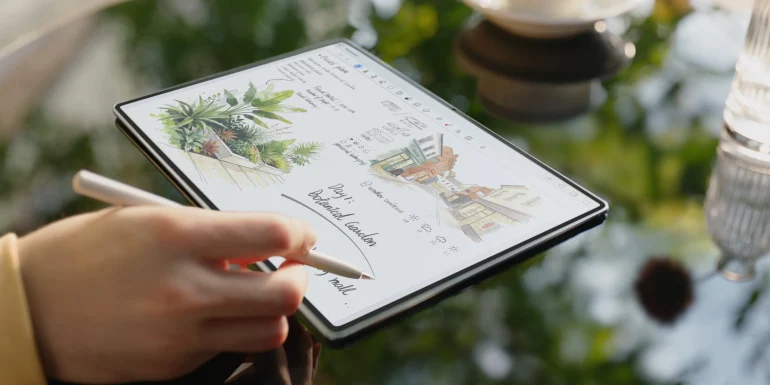
The Huawei MatePad Pro Max arrived at a Bangkok launch event today with a spec that’s harder to dismiss than most: at 4.7mm thick and 499g, it’s measurably thinner and lighter than the 13-inch iPad Pro M4, which runs 5.1mm and 582g. That’s not a marginal difference on paper, and on a 13-inch device, it translates to something you’d actually notice when you’re carrying it.
Huawei has been competing in the premium tablet space for years, iterating steadily on display technology and form factor. The MatePad 11.5S 2026 — announced in Dubai late last year — showed the same approach: incremental but purposeful refinement rather than feature drops for their own sake. The Pro Max is a harder move. It’s Huawei entering the benchmarking conversation that Apple has owned with the iPad Pro, and doing so with a verifiable number.
The display is a 13.2-inch 3K flexible OLED panel with 144Hz refresh, 1,600 nits peak brightness, and 1,440Hz PWM dimming for eye strain reduction. Bezels measure 3.55mm across all four sides, with the 12MP front camera embedded in the bezel itself rather than notched or punched through the screen. Huawei is also offering a PaperMatte Edition, which adds the anti-glare texture familiar from the 11.5S range, at 509g instead of 499g. The battery is 10,400mAh, which Huawei claims delivers around 14.5 hours of local video playback, with 40W reverse wireless charging included. Getting a battery of that capacity into a 4.7mm chassis is a meaningful engineering outcome. The usual compromise when brands chase thinness is battery capacity; Huawei has avoided it here, at least on paper.
Performance specs include a 20% improvement over the MatePad Pro 2025 and a dual vapour chamber cooling system designed to manage heat in the slim chassis. The tablet ships in 12/256GB and 12/512GB configurations, priced from £999.99, with Blue and Space Gray colourways. Regional availability will vary, and South African pricing hasn’t been confirmed.
The productivity pitch is the familiar one: keyboard accessory, stylus input, PC-level WPS Office. Huawei frames this as a laptop alternative, which is a narrative that’s been circulating in the tablet space for most of the last decade without fully resolving. What’s different now is that the hardware case is more credible than it was. The remaining friction, for users outside of Huawei’s ecosystem, is HarmonyOS. The operating system is capable, and it has matured, but workflows that depend on Google Mobile Services still require workarounds that add variable degrees of inconvenience depending on what you actually use.
The question for South African buyers who are considering the MatePad Pro Max is a practical one. With no launch date currently on the cards for the device, it seems like prospective buyers will have to purchase the device elsewhere. No matter where you purchase it, though, it’ll be competing against an iPad Pro M5 that costs roughly the same or more, depending on configuration and timing. The hardware comparison isn’t unflattering for Huawei. The software comparison is more complicated, and it always has been. If your workflow runs comfortably on HarmonyOS and AppGallery, or if you’re already in Huawei’s device ecosystem, the Pro Max is a genuinely compelling device. If it isn’t, the thinness record doesn’t change that calculation.