
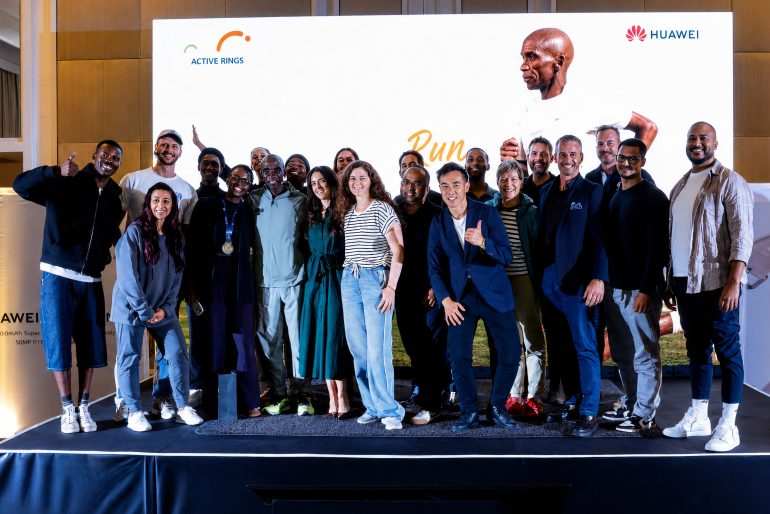
The Huawei WATCH GT Runner 2 landed in South Africa in April, but it took a Kenyan legend finishing his first marathon on African soil to give the watch its local narrative. Eliud Kipchoge’s appearance at the Sanlam Cape Town Marathon last weekend was the anchor for Huawei’s most direct push yet into a category long controlled by Garmin.
That matters because Kipchoge isn’t just a face on the packaging. He served as co-developer on the watch’s core features, working alongside the DSM-Firmenich Running Team to shape how the device handles race pacing, running power analysis, and marathon-specific guidance. Huawei claims that elite training intelligence, the kind previously accessible only to professional runners with dedicated coaching infrastructure, is now available from the wrist at R6,999. Given that a Garmin Forerunner 965 retails in South Africa for well above R10,000, and the Forerunner 970 even more, that’s a real challenge.
The Cape Town Marathon is a World Athletics Label Road Race, which makes it a direct use case for the watch’s Intelligent Marathon Mode: a feature that tracks certified courses in real time, offering dynamic pace guidance and smart refuel reminders kilometre by kilometre. There’s something coherent about Huawei choosing to demonstrate this at a race that’s structurally exactly what the feature is built for.
What Huawei’s announcement doesn’t address is the ecosystem question. Garmin’s hold on serious runners isn’t purely about hardware. The Garmin Connect training platform, offline mapping, and years of accumulated training data create a loyalty that specifications alone don’t break. The GT Runner 2’s GPS accuracy improvements are credible: a 3D floating antenna architecture said to produce a signal 3.5 times stronger than its predecessor, paired with an AI-assisted XDR positioning system that uses motion data to maintain tracking when satellite signals drop. But runners who’ve trained within Garmin’s ecosystem for years aren’t switching for a better antenna. They’re switching to a better platform, and Huawei is still building that case.
Where the GT Runner 2 is objectively competitive is in hardware value. Aerospace-grade titanium at 43.5 grams, up to 14 days of battery life, and non-intrusive lactate threshold detection without an external sensor represent meaningful differentiation at this price in South Africa. Garmin and Apple equivalents with comparable build quality and running intelligence routinely exceed R15,000 locally. At R6,999, the GT Runner 2 doesn’t need to win on ecosystem depth. It needs to be good enough, and on hardware alone, it’s making a credible argument.
Kipchoge’s Cape Town appearance also carried weight outside the product launch. His run at the Sanlam Cape Town Marathon was his first official marathon on African soil, the opening leg of Eliud’s Running World, a two-to-three-year project to race marathons across all seven continents. For a Kenyan athlete with two Olympic gold medals and eleven Abbott World Marathon Majors titles, the gesture toward a continent whose runners have shaped the sport for decades isn’t hollow. Huawei attaching itself to that moment is commercially deliberate, but the moment itself is genuine.
South Africa’s running culture, shaped by Comrades, Two Oceans, and a Cape Town Marathon that has grown into a serious international event, is a real and active market for this category. The question is whether runners considering a GT Runner 2 at R6,999 are willing to accept a watch that performs like Garmin without the Garmin ecosystem. For a significant portion of the market, particularly those new to performance running or moving up from general smartwatches, the answer’s likely yes.
The HUAWEI WATCH FIT 5 Pro and HUAWEI nova 15 Max also featured in Huawei’s Cape Town showcase. The FIT 5 Pro rounds out the health-monitoring side of the portfolio with the TruSense technology Huawei has been refining since its Berlin launch last year, targeting everyday fitness users rather than marathoners; the nova 15 Max carries Huawei’s broader proposition around its 8,500 mAh battery and AI camera system. Both are coherent additions to the ecosystem story, but neither was the point of this weekend.
Five years elapsed between the original GT Runner, launched in 2021, and this successor. That’s a long development cycle, and the GT Runner 2 is the first in the lineup to go on official sale in South Africa. It arrives without a local predecessor to compare against, which removes one obstacle. It simply needs to be good enough to earn the first sale.