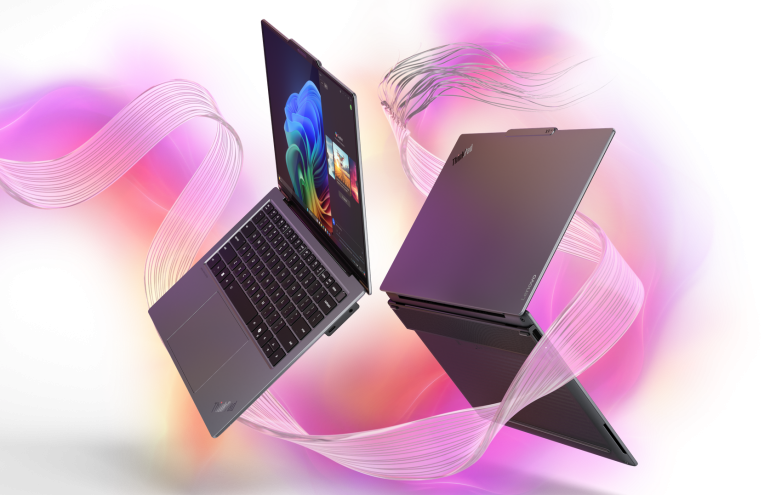
For most of its life, the ThinkPad brand has survived by doing the opposite of chasing attention. Black slabs, red TrackPoint, zero interest in how it looked on a café table. The Lenovo ThinkPad X9 changes that unspoken agreement immediately, and the white model does it without apology. This is a ThinkPad that wants to be noticed, and more unusually, expects to be complimented.
That isn’t theoretical. I travelled with the white X9 to AWS re:Invent in Las Vegas, a conference crawling with laptops and people who see hundreds of them a week. Journalists commented on it. Repeatedly. That simply doesn’t happen with business machines, and certainly not with ThinkPads. Lenovo knows exactly what it’s doing here. The X9 is a signal, not just a product.
Design is the entire point. The finish, the proportions, the way it looks closed on a table all suggest Lenovo is done pretending aesthetics are secondary. It’s still restrained, but it’s no longer anonymous. This matters more than it sounds. Business laptops don’t live exclusively in boardrooms anymore. They’re carried through airports, used on stage, opened in public spaces. Visibility has become part of the job.
There’s an interesting parallel here with how refinement often replaces ambition once a category matures. When brands stop questioning their own assumptions, polish can slide into complacency. We’ve seen that play out elsewhere, including with devices that technically improve while conceptually standing still. The ThinkPad X9 avoids that trap by making its intent explicit. It isn’t neutral. It’s choosing to evolve the brand’s posture, not just its chassis.
That shift would fall apart if the fundamentals didn’t hold. The 14-inch display is sharp, clean, and comfortable over long stretches. Brightness is good enough for conference halls, cafés, and airport lounges, and the tuning prioritises clarity over drama. It’s a screen designed for all-day work rather than short bursts of spectacle, which fits the machine’s intent.
Underneath its new confidence, the X9 remains recognisably ThinkPad. The keyboard is excellent. Not flashy, not experimental, just quietly better than almost everything else in this size class. If Lenovo had compromised here, the whole exercise would’ve collapsed. Instead, it anchors the aesthetic shift in something familiar and dependable.
Portability reinforces that impression. The X9 is light enough that it never feels like a burden, even when carried all day. It slips easily into a bag and disappears until it’s needed. That matters more in real use than chasing ultra-thin bragging rights.
Ports remain reassuringly practical. Lenovo hasn’t chased minimalism for its own sake, and you’re not immediately forced into dongle life. For a business-oriented machine, that restraint feels deliberate and welcome, especially in environments where presentations, peripherals, and unfamiliar displays are still normal.
Performance follows the same logic. It’s responsive, composed, and tuned for people who do actual work rather than chase benchmark screenshots. The X9 feels most comfortable with knowledge work, development, writing, research, data-heavy browser sessions, and long stretches of multitasking. It doesn’t pretend to be a creative workstation or a gaming machine, and that honesty is part of its appeal.
Battery life lands squarely in the modern Windows middle ground. Good enough for a full workday if you’re disciplined, but not the kind of endurance that changes behaviour. Lenovo has opted for balance rather than spectacle, which fits the broader character of the machine.
In South Africa, pricing sharpens the decision. The ThinkPad X9 sits firmly in premium territory, where buyers compare more than specs. They compare ecosystems, longevity, resale value, and status. If you’re cross-shopping thin, well-built laptops at this level, the X9 will feel more expressive than traditional business machines but more restrained than lifestyle-first alternatives. You’re paying for a specific blend of credibility and presence.
The official local listing positions the X9 as a flagship expression of what ThinkPad can be now, not a side experiment.
Who shouldn’t buy this laptop is just as important as who should. If you want maximum performance per rand, class-leading battery life, or a machine that disappears entirely into corporate uniformity, the ThinkPad X9 will feel indulgent. If your work leans heavily on sustained GPU performance or demanding creative pipelines, this isn’t the right tool.
What the ThinkPad X9 ultimately represents is an admission. The old ThinkPad logic no longer covers every modern work scenario. Professional credibility and visual appeal now overlap, and Lenovo is testing how far that overlap can stretch without snapping the brand.
It won’t satisfy every loyalist. It won’t convert the aggressively price-conscious. But for professionals who want a serious Windows laptop that doesn’t look apologetic, the X9 makes a clear, considered case for itself.