
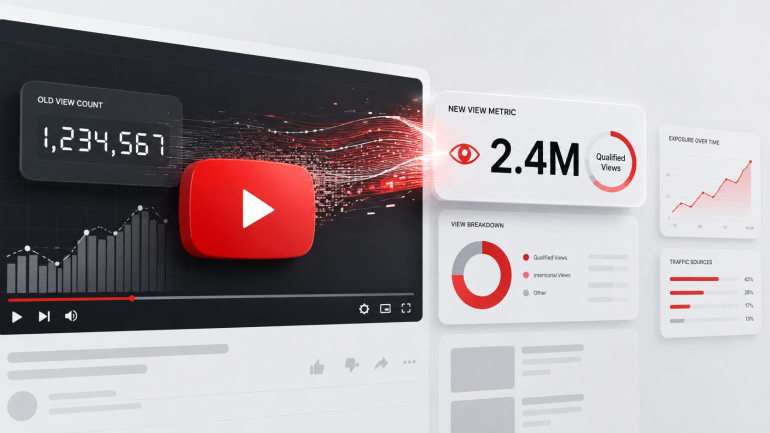
From 24 August, YouTube videos will start accumulating views under a different definition, even though the millions or billions of views they’ve already collected were counted under the old one. YouTube will begin counting a public view from the first frame of a video, bringing the rest of the platform into line with Shorts. The company says it’s making the change because it has historically used different counting systems across formats, which has made it harder for creators to understand their overall exposure. From 24 August, one standard will apply globally across YouTube.
YouTube does have a consistency problem to solve here. Creators increasingly publish across Shorts, conventional videos and other formats without treating them as completely separate worlds, yet the numbers attached to those formats haven’t always measured the same thing. YouTube changed how it counts Shorts views in March 2025, so that a view counts whenever a Short starts or replays, with no minimum watch-time requirement. The previous measurement was retained as “engaged views”. Bringing the rest of YouTube into the same system removes that inconsistency, but it also means that a video with 500,000 views accumulated before the change and one that reaches 500,000 afterwards can display the same number even though the threshold for adding those views wasn’t the same.
YouTube views don’t stay inside YouTube Analytics. They appear in creator media kits, sponsorship decks, press releases and news stories. Record labels celebrate them, fans use them as evidence that one artist is bigger than another, and creators routinely use view counts to establish the scale of their audiences and part of their commercial value. A billion views can become a cultural milestone in its own right, giving the public counter a significance well beyond the mechanics of platform analytics.
After 24 August, that familiar number will describe something slightly different. A video starting is still meaningful because someone had to encounter it, and the title, thumbnail, recommendation system or creator’s existing audience got them far enough for playback to begin. If YouTube wants one measure of how widely its videos start circulating, counting starts makes sense. The number can’t tell you whether the person who triggered that view stayed for a few seconds or watched most of the video.
YouTube doesn’t appear to consider those behaviours equivalent either, because it isn’t abandoning the old measurement. The previous view metric will remain available in Advanced Mode as “Engaged views”, allowing creators to see how many people chose to continue watching. Creator earnings will still be based on Engaged Shorts views and Engaged Watch Hours, while YouTube Partner Programme eligibility will continue to use stricter measures. The terminology is changing slightly, with “valid public Shorts views” and “valid public watch hours” becoming “qualified Shorts views” and “qualified watch hours”, but the eligibility requirements themselves aren’t changing.
There isn’t one perfect metric for audience behaviour. Watch time favours longer content in ways that raw views don’t, completion rates mean something different on a 20-second Short and a 45-minute interview, and unique viewers answer another question again. YouTube uses engaged views when estimating unique viewers for Shorts, because those are the people who stayed to watch rather than merely triggering playback. Expecting the public view count to settle every question about audience size, attention and value was always asking too much of it.
Bigger numbers, but not necessarily bigger audiences
YouTube says the new system will give creators a clearer picture of their overall exposure and make it easier to communicate their “true scale and value” to brand partners and sponsors. It also acknowledges that creators are likely to see their total view counts increase faster after 24 August.
Scale is easy enough to defend in this context. If a video starts two million times, two million starts happened. For a brand buying exposure, that might be exactly the number it wants, and a campaign designed to put a product in front of as many people as possible doesn’t become worthless because some of those people leave quickly. Value is harder to compress into the same figure because the right measurement depends on what the campaign was meant to achieve.
A brand paying for a lengthy sponsored segment may care much more about whether viewers reached that point than how many times the video started. Another advertiser may care about clicks, conversions or sales and regard both public views and engaged views as intermediate signals. A music label might care about repeat exposure, while a publisher could be more interested in whether viewers return regularly. The new view count can’t answer all of those questions, nor does it need to.
Creator advertising has a practical reason to favour shorthand. “This channel averages 300,000 views” works far better in a pitch than a bundle of retention charts, engaged-view figures and watch-hour data. The simpler number travels because everyone thinks they already understand it. From 24 August, historical comparisons will need more care because some of the apparent change in performance may come from the audience and some may come from the counting method.
If a creator’s monthly views rise sharply after the change, the public counter won’t tell you how much of that increase came from stronger distribution or a larger audience and how much came from the new definition. A journalist comparing 2027 performance with 2025, an agency benchmarking a campaign against an older one, or a creator presenting year-on-year growth could all be comparing figures produced under different definitions while using exactly the same word.
Keeping the old counting system indefinitely would create problems of its own. YouTube’s formats have changed, the way people encounter video on the platform has changed, and Shorts had already moved public counting towards starts and replays. A common exposure metric makes more sense for a platform that increasingly mixes those formats together. Historical continuity is one of the things YouTube is giving up to get there.
The word “view” carries more cultural weight than its technical definition suggests. We don’t usually say a music video generated 200 million playback starts. We say it got 200 million views, and that wording sounds closer to consumption than exposure even though platform measurements have always been more complicated than the sentence suggests.
This extends beyond individual creators. South Africa’s next newsrooms are increasingly being built around YouTube, newsletters and social platforms, with publishers and creators using the same platforms to build audiences and then sell access to those audiences commercially. The numbers produced by those platforms inevitably follow them into sales decks, sponsorship proposals and claims about reach.
Digital metrics can look unusually objective because they arrive with precise numbers attached to them. A figure such as 12,483,721 views feels harder than a television audience estimate or a circulation figure, but the precision doesn’t remove the judgement involved in deciding what qualifies for the count. YouTube is changing that judgement on 24 August: for the public counter, a view will begin at the first frame, while monetisation, qualification and deeper analysis will continue to rely on other measures.
The word “view” isn’t becoming meaningless. It’s becoming more specific. After 24 August, it will tell us that a video started playing. Everything we want to infer from what happened after that will require another number.