

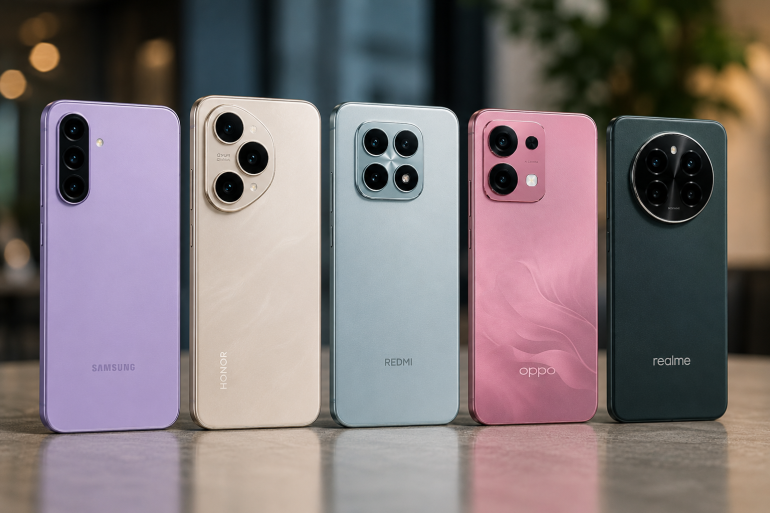
The R7,000 to R15,000 smartphone band is currently the most contested space in South African consumer electronics. As flagship prices push past R20,000, more buyers have stopped justifying the premium and settled into the middle of the market. Samsung, HONOR, Xiaomi, and OPPO are competing for the same buyer in that range, and what’s actually moving units there has a different answer depending on who you ask.
Manufacturers have settled on AI as the key narrative. Samsung’s Galaxy A37, which launched in locally at R8,699, and the Galaxy A57 at R11,999, both carry what Samsung calls Awesome Intelligence, including voice transcription, AI Select, Object Eraser, Circle to Search, and Gemini integration. HONOR’s mid-range devices lead with AI-driven camera processing. Xiaomi’s Redmi Note series markets on-device AI optimisation. At nearly every price point above R7,000, some form of AI branding appears in the spec sheet or the launch materials.
Consumer data doesn’t support that framing. A May 2026 survey picked up by MacRumors and MacObserver, conducted by YouGov across 2,407 US smartphone owners, found that price remains the primary driver of upgrade decisions at 55%, followed by battery life at 52% and storage at 38%. Camera quality came in at 27%. AI as an upgrade motivator sits at 12%, having dropped sharply from 2024 before recovering slightly this year. A separate Mintel report found that 66% of consumers believe AI’s usefulness in smartphones is overstated. That’s a majority position held across a broad demographic, not a niche scepticism.
Counterpoint Research’s December 2024 consumer survey across seven countries found that 59% of respondents were open to switching to a Gen AI device within a year, with over two-thirds saying they’d pay more for one. But Counterpoint’s market analysis in the same period noted that GenAI applications had yet to attract strong consumer interest, with manufacturers still working out which use cases are practical enough to actually move buyers. Stated intent and purchase behaviour have rarely tracked closely in consumer surveys, and the smartphone category is no exception.
A Light Reading report from April 2026 found that consumers replacing phones in 2026 are mostly doing so because something stopped working, a carrier made an offer they couldn’t ignore, or a three-year-old device had finally run its course. AI may inform which device someone picks at the point of purchase. It’s rarely the reason they’re shopping at all.
HONOR’s trajectory in South Africa is a useful read on how this market actually works. The 200 Lite became the country’s best-selling postpaid smartphone in 2024 by leading on battery life, display quality, and a price that didn’t require a difficult financial conversation. The brand has extended that model across the 600 series. The HONOR 600 Lite is now available at R8,999 outright, from R399 per month on Vodacom and R499 per month on Cell C over 36 months, and at R9,499 through Cellucity. The HONOR 600 and 600 Pro have since been listed on the HONOR South Africa website, with official local pricing still to come. Both carry 7,000mAh batteries and a 200MP main camera, with the Pro adding a Snapdragon 8 Elite chipset and 5G. HONOR’s AI camera features, including Motion Snap, Image-to-Video, and AI Super Zoom, are part of the pitch, but the battery and pricing credentials are what open the door in this market first.
In South Africa, the economics of the mid-range are sharpened by long upgrade cycles and real household income constraints. Buyers in the R8,000 to R12,000 band aren’t primarily asking whether a phone has generative AI features. They want a device that survives a full day, handles WhatsApp and data-heavy applications without stuttering, and doesn’t force a difficult payment plan conversation. Those requirements haven’t shifted.
What has shifted is pricing pressure across the segment. Memory chip costs, partly driven by AI infrastructure demand in data centres, are feeding through to consumer device pricing. Counterpoint and IDC both flagged meaningful price increases in 2025 and 2026, with mid-range Android devices carrying the sharpest impact because of thin margins.
The market where AI is gaining genuine mid-range traction is worth noting for what it tells you about conditions. Counterpoint’s Flipkart-commissioned Smartphone Insights Report 2026 found that in India’s mid-range segment, nearly 89% of consumers said AI features influence their purchase decisions, a shift from AI as a differentiator to an expected baseline. That’s a market with different income dynamics and a higher concentration of buyers upgrading from much older devices, where AI features represent a meaningful step change. South Africa’s mid-range buyers are more likely to track the broader global pattern, where the practical bar for switching is real, upgrade cycles run long, and value sensitivity is high.
AI features are part of the conversation, and they do influence some purchase decisions. But battery life, build quality, display performance, and price are what’s winning the R7,000 to R15,000 segment.