
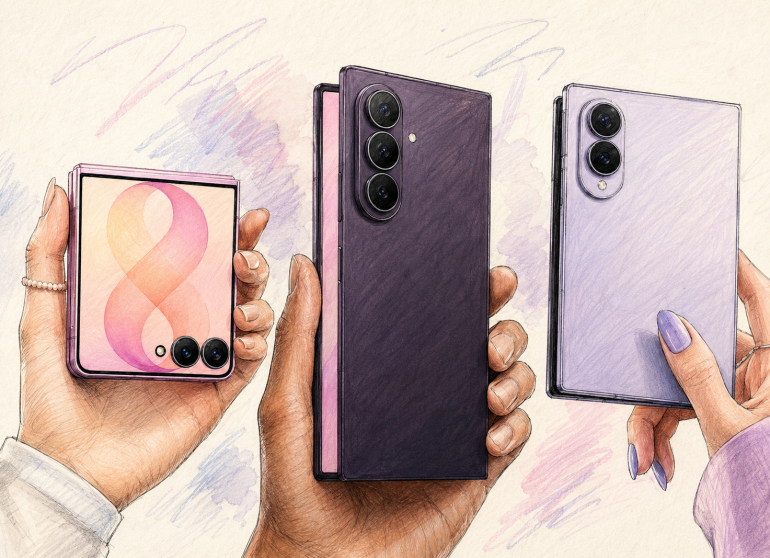
The Samsung Galaxy Z Fold8 Ultra vs Z Fold8 vs Z Flip8 comparison isn’t a conventional choice between good, better and best. Samsung has built three foldables around different ideas of what a folding phone should do, and the most expensive model won’t automatically be the right one.
The Galaxy Z Flip8 is a 6.9-inch smartphone that folds into a smaller shape when you put it away. The Galaxy Z Fold8 is a short, wide phone with an outer display large enough for content and everyday tasks, which opens into a larger screen for reading, entertainment and work. The Galaxy Z Fold8 Ultra follows the book-style formula people already know, combining a conventional 6.5-inch outer display with an 8-inch screen inside.
That makes the Fold8 Ultra the most familiar of Samsung’s two Folds, but early demand suggests the less conventional Fold8 may be the phone expanding the category. Its passport-sized design is attracting younger buyers and women in South Korea who previously saw book-style foldables as expensive productivity devices built for older men.
Samsung Galaxy Z Fold8 Ultra vs Z Fold8 vs Z Flip8 specifications
| Specification | Galaxy Z Fold8 Ultra | Galaxy Z Fold8 | Galaxy Z Flip8 |
|---|---|---|---|
| Main display | 8-inch QXGA+ Dynamic AMOLED 2X, 2504 × 2256, 422ppi, 1-120Hz | 7.6-inch QXGA+ Dynamic AMOLED 2X, 1848 × 2448, 403ppi, 1-120Hz | 6.9-inch FHD+ Dynamic AMOLED 2X, 1080 × 2520, 400ppi, 1-120Hz |
| Cover display | 6.5-inch FHD+ Dynamic AMOLED 2X, 1080 × 2520, 422ppi, 1-120Hz | 5.5-inch WUXGA+ Dynamic AMOLED 2X, 1248 × 1972, 428ppi, 1-120Hz | 4.1-inch Super AMOLED, 948 × 1048, 342ppi, 60/120Hz |
| Folded dimensions | 72.8 × 158.4 × 8.9mm | 81.9 × 123.9 × 9.7mm | 75.4 × 85.7 × 13.1mm |
| Unfolded dimensions | 143.2 × 158.4 × 4.1mm | 161.4 × 123.9 × 4.5mm | 75.4 × 166.9 × 6.1mm |
| Weight | 215g | 201g | 180g |
| Processor | Snapdragon 8 Elite Gen 5 for Galaxy | Snapdragon 8 Elite Gen 5 for Galaxy | Exynos 2600 |
| South African RAM and storage | 12GB + 512GB; 16GB + 1TB | 12GB + 256GB; 12GB + 512GB | 12GB + 256GB |
| Rear cameras | 200MP wide, 50MP ultra-wide, 10MP 3x telephoto | 50MP wide, 50MP ultra-wide | 50MP wide, 12MP ultra-wide |
| Selfie cameras | 10MP cover, 10MP inner | 10MP cover, 10MP inner | 10MP |
| Battery | 5,000mAh | 4,800mAh | 4,300mAh |
| Wired charging | 45W | 45W | 25W |
| Wireless charging | 20W | 20W | 15W |
| Reverse wireless charging | Yes | Yes | Yes |
| Water and dust resistance | IP48 | IP48 | IP48 |
| Connectivity | 5G, Wi-Fi 7, Bluetooth 6.0 | 5G, Wi-Fi 7, Bluetooth 6.0 | 5G, Wi-Fi 7, Bluetooth 5.4 |
| Software | Android 17, One UI 9 | Android 17, One UI 9 | Android 17, One UI 9 |
| S Pen support | No | No | No |
| South African price | R50,999 for 512GB; R60,999 for 1TB | R40,999 for 256GB; R45,999 for 512GB | R26,999 for 256GB |
The Fold8 Ultra is the familiar Fold
The Galaxy Z Fold8 Ultra is the easier of Samsung’s two book-style foldables to understand. Closed, its 6.5-inch outer display has the proportions and resolution of a conventional flagship phone, so most apps should feel natural without requiring you to open the device.
Unfolding it reveals an 8-inch display with an almost square aspect ratio and enough room for several apps. It measures 4.1mm thick when open and 8.9mm when closed, while its 215g weight is lighter than several conventional Ultra phones despite the additional display and hinge.
The Ultra name mostly earns its place through the camera system. Samsung has equipped it with a 200MP wide camera, 50MP ultra-wide and 10MP telephoto offering 3x optical zoom. It’s the only phone in this comparison with a dedicated telephoto camera, while the Fold8 and Flip8 use 50MP main sensors and rely on sensor cropping when zooming beyond their native focal lengths.
Its 5,000mAh battery is also the largest of the three, although the advantage over the Fold8’s 4,800mAh capacity is relatively small. Both Fold models support 45W wired charging, 20W wireless charging and Wireless PowerShare, and both use the Snapdragon 8 Elite Gen 5 for Galaxy.
The Fold8 Ultra therefore doesn’t offer a separate tier of processor performance from the Fold8. Its extra cost pays for the larger and more conventional outer display, a slightly larger inner screen, the more complete camera system and another 200mAh of battery capacity.
That package will make sense to buyers who want a Fold without surrendering the conventional flagship experience. It doesn’t necessarily make the Ultra the safer purchase, because familiarity is only an advantage if you want your foldable to behave like the phone you already own.
The Fold8 may be the phone that changes who buys a foldable
The Galaxy Z Fold8 looks like the more experimental of Samsung’s two Folds. Its 5.5-inch outer display sits in a short, wide body measuring 81.9mm across and only 123.9mm tall when closed, giving it proportions closer to a passport than a conventional smartphone.
That shape changes how the phone fits into everyday life. The outer display remains large enough for watching video, reading messages, scrolling through social media and handling ordinary apps, but the phone occupies considerably less vertical space in a pocket or bag than the Fold8 Ultra. Opening it gives you a 7.6-inch display for reading, working across multiple apps or watching something for longer.
The Fold8 also weighs 201g, making it 14g lighter than the Ultra and only 21g heavier than the Flip8. Its design isn’t simply a reduced version of the Ultra. Samsung has traded the familiar outer-screen proportions for a device that feels more compact when closed and becomes more useful when opened.
Early South Korean demand suggests that choice has reached people who hadn’t previously considered a book-style foldable. The Fold8 accounted for roughly 70% of the 1.44 million pre-orders recorded for Samsung’s new foldable range in South Korea, helping to explain why the Galaxy Z Fold8 may have found the foldable sweet spot. That total was 39% higher than pre-orders for the previous Z series.
Buyers from their teens through their 30s made up more than half of Fold8 purchases through Samsung’s Korean online store. Purchases by women in that age group more than doubled compared with the previous model, while Samsung has said the Fold is beginning to lose its image as a phone for older men who want a large screen for work.
The underlying demographic figures come from Samsung’s own online store in South Korea, so they shouldn’t be treated as a prediction of how South Africans will respond. Several reports about the Fold8’s changing audience also rely on the same Samsung-supplied data, rather than independent studies reaching identical conclusions.
The scale of the response is still difficult to dismiss. Seoul Economic Daily reports that some Fold8 configurations sold out through Samsung’s Japanese online store, while pre-orders for the wider Z8 series increased by more than 30% in the US and more than 20% in Europe.
The appeal to younger buyers and women shouldn’t be reduced to Lavender and Pistachio colour options, although those certainly help separate the Fold8 from the grey office equipment aesthetic traditionally associated with large foldables. The shape reflects how people actually use their phones, with a compact display outside for quick interactions and a wider screen inside for video, social media, reading and work.
The Fold8’s camera system is less complete than the Ultra’s, although it has an unusual advantage over the Flip8. Its 50MP wide and 50MP ultra-wide cameras provide high-resolution capture at both focal lengths, but there’s no dedicated telephoto lens. The Fold8 Ultra remains the better option for anyone who regularly photographs distant subjects or wants the most versatile camera system.
Its 4,800mAh battery sits close to the Ultra’s 5,000mAh capacity, and the phones share the same processor and charging speeds. The smaller Fold should therefore surrender relatively little everyday performance, although the different body shapes and cooling systems may affect how they handle sustained workloads.
Samsung hasn’t made the Fold8 cheaper by turning it into a compromised mid-range device. It has used a different form factor to separate the two models, then reserved the Ultra’s camera system and larger displays for buyers willing to pay more.
The Flip8 is about becoming smaller
The Galaxy Z Flip8 folds in the opposite direction and solves a different problem. Its 6.9-inch main display has the tall proportions of a conventional smartphone, while folding it reduces the phone to 75.4 × 85.7mm.
The Flip8 is 13.1mm thick when closed, making it thicker than either Fold, but its much smaller footprint is the attraction. It weighs 180g and measures 6.1mm thick when open, making it the lightest of Samsung’s three new foldables even though it isn’t the thinnest.
Its 4.1-inch FlexWindow can display notifications, widgets and supported apps without requiring the phone to be opened. It also works as a preview when taking photos with the rear cameras, allowing the 50MP main or 12MP ultra-wide camera to be used for selfies.
The folding design gives it several camera positions that a conventional phone can’t reproduce. It can stand partially open for hands-free photographs, video calls and recording, while the outer display lets the person being photographed see the frame.
The Flip8 doesn’t create a tablet-style workspace when opened. It gives you a conventional large-screen phone that occupies less space when you put it away, which makes its portability advantage more direct than the Fold8’s attempt to combine a compact phone with a larger internal display.
Samsung has equipped it with the Exynos 2600 instead of the Snapdragon processor used by the Fold models. It still has 12GB of RAM and should offer flagship-level everyday performance, but the Fold8 and Fold8 Ultra are better suited to demanding multitasking across several apps.
The Flip8 also has the smallest battery and slowest charging in the range. Its 4,300mAh capacity is paired with 25W wired and 15W wireless charging, compared with 45W and 20W respectively on the Fold models. Battery capacity alone doesn’t determine endurance, particularly across phones with different display sizes and processors, but the Flip8 has less capacity available if you’re a heavy user.
The Ultra has the best cameras, but the Fold8 may be easier to live with
The Fold8 Ultra wins most straightforward hardware comparisons. It has the largest displays, biggest battery and only optical telephoto camera, while its outer screen will feel the most natural to anyone moving from a conventional flagship.
The Fold8’s advantages become clearer once size stops being treated as an automatic measure of quality. It provides a 7.6-inch inner display in a phone that’s considerably shorter when closed, while its 201g weight makes it easier to carry than the Ultra.
Its 5.5-inch cover display isn’t intended to replace the inner screen for every task. It allows you to watch content, reply to messages and use ordinary apps without unfolding the phone, then gives you the larger display when the extra space improves what you’re doing. That is a different philosophy from the Ultra, where the conventional outer screen makes opening the phone more optional.
The choice resembles the broader split emerging across the foldable market. Some devices, including the phones in our Huawei Mate X7, Mate X6, Honor Magic V5 and Galaxy Z Fold7 comparison, try to make a foldable feel as much like a conventional flagship as possible. The standard Fold8 is more willing to let its folding design change the shape and rhythm of the phone.
Neither Fold supports the S Pen. Pursuing thinner and lighter foldables has left Samsung’s two large-screen models without the digitiser required for stylus input, which means neither can be used for handwritten notes or precision drawing with an S Pen. Samsung’s South African product pages confirm that neither the Galaxy Z Fold8 nor the Galaxy Z Fold8 Ultra supports the S Pen.
The omission is particularly noticeable on the Fold8 Ultra because Samsung positions it as a mobile productivity device and charges as much as R60,999 for the 1TB model. The larger workspace remains useful for documents and multitasking, but productivity is being defined entirely around touch and software.
All three phones have an IP48 rating. Samsung says they can withstand submersion in up to 1.5 metres of fresh water for 30 minutes under laboratory conditions, while the “4” indicates protection against solid objects larger than 1mm. That’s useful for a foldable, but it remains weaker dust protection than the IP68 rating common on conventional flagship phones.
South African pricing changes the choice
The Galaxy Z Flip8 256GB has a recommended South African price of R26,999. The Fold8 starts at R40,999 for 256GB and costs R45,999 with 512GB, while the Fold8 Ultra costs R50,999 for 512GB and R60,999 with 1TB.
Those prices create two different comparisons between the Fold models. The entry-level Fold8 costs R10,000 less than the 512GB Ultra, although the cheaper phone also has half the storage. That’s a meaningful saving for anyone who can comfortably live with 256GB.
Comparing the 512GB versions reduces the difference to R5,000. The Ultra’s 200MP main camera, telephoto lens, larger displays and additional battery capacity become considerably easier to justify at that point, particularly for buyers already prepared to spend R45,999.
The Fold8’s stronger argument is therefore attached to its 256GB model and its form factor. Someone who prefers the smaller design won’t necessarily see the Ultra as an upgrade, because spending more also means buying a larger phone with a different relationship between its inner and outer displays.
The Flip8 is R14,000 cheaper than the entry-level Fold8, but the price difference doesn’t make the two direct substitutes. The Flip8 becomes smaller when folded, while the Fold8 gives you a substantially larger display when opened. Buyers need to decide which transformation is more useful before comparing the numbers.
Pre-orders for the new Galaxy Z8 series run until 12 August 2026, with the phones officially available in South Africa from 13 August. The locally priced configurations are the Flip8 with 256GB, Fold8 with 256GB or 512GB, and Fold8 Ultra with 512GB or 1TB.
Which Samsung Galaxy Z8 foldable should you buy?
The Galaxy Z Fold8 is the most interesting choice for anyone who wants the folding design to change how the phone fits into their life. Its outer display remains large enough for video and everyday tasks, while the 7.6-inch inner screen gives you room for work, reading and longer viewing. Early South Korean demand suggests the passport-sized shape is also attracting younger people and women who hadn’t previously seen themselves as Fold buyers.
The Galaxy Z Fold8 Ultra is better suited to buyers who want a foldable without giving up the familiar proportions and camera flexibility of a conventional Ultra flagship. It has the strongest camera system, largest screens and biggest battery in the range, while the R5,000 difference between the 512GB Fold8 and 512GB Ultra makes it a persuasive upgrade when storage is matched.
The Galaxy Z Flip8 is the choice for anyone whose priority is carrying a smaller phone. It offers a full-sized 6.9-inch screen when open, a useful 4.1-inch FlexWindow when closed and camera positions that the Fold models can’t reproduce. Its weaker ultra-wide camera, smaller battery and slower charging are the compromises attached to its lower price and lighter body.
Samsung’s 2026 foldables no longer sit in a tidy hierarchy. The Fold8 Ultra has the strongest hardware and the most familiar design, while the Flip8 remains the clearest answer for portability. The standard Fold8 is making the more consequential argument by challenging the assumption that a book-style foldable must resemble a business tool built for an older male buyer. Early South Korean demand can’t tell us whether that change will travel, but it makes the Fold8 the model worth watching and, for more buyers than Samsung may have expected, possibly the one worth buying.