
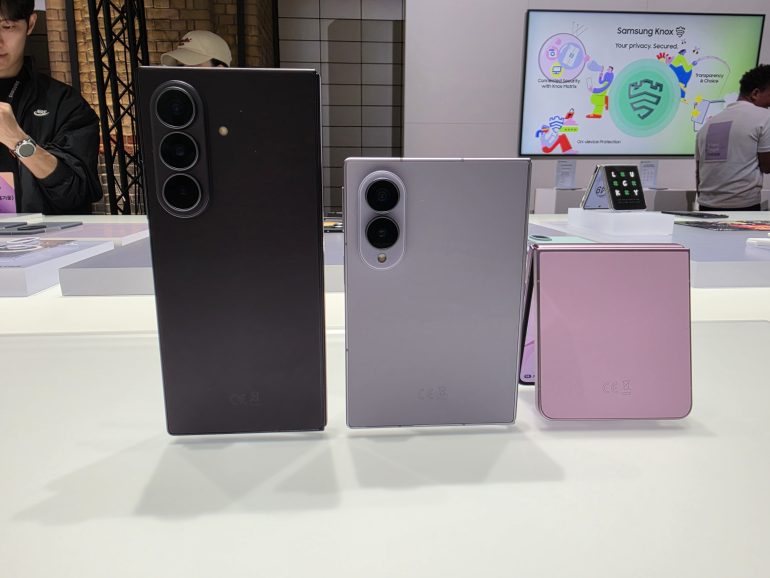
For most of Samsung’s foldable era, the easier phone to understand was the Galaxy Z Flip. It took the smartphone people already knew and folded it in half, making a large-screen phone considerably smaller when it was in your pocket without asking you to rethink what a smartphone should look like when you were actually using it. Buyers responded accordingly. Samsung said 70% of its foldable shipments in 2021 were Flip-style devices, and the clamshell remained the more sought-after format for several generations.
That balance had already started changing before Samsung introduced the Galaxy Z Fold8. Counterpoint Research says Galaxy Z Fold7 shipments overtook Galaxy Z Flip7 shipments in the second half of 2025, while book-style devices are expected to account for 65% of global foldable shipments in 2026, up from 52% last year. The Flip hasn’t suddenly become irrelevant, but the assumption that clamshells are naturally the mass-market foldable and book-style devices the expensive enthusiast alternative was already becoming harder to sustain.
The Galaxy Z Fold8 has made that shift considerably more difficult to ignore. Samsung recorded 1.44 million preorders for the Fold8, Fold8 Ultra and Flip8 in South Korea between 28 July and 3 August, the highest preorder total for any Galaxy smartphone launch. Around 70% of those orders went to the Fold8, meaning Samsung’s short, wide foldable accounted for roughly one million preorders by itself. SK Telecom and KT both reported that more than half of their Z8 customers chose it, while LG Uplus put the proportion at 67.4%.
Price obviously plays some role. The Fold8 is cheaper than the Fold8 Ultra, but South Korea is also the market where Samsung has made both devices substantially cheaper than they are elsewhere. The 256GB Fold8 costs the equivalent of about $1,541 there, compared with $1,899 in the US and considerably more in Europe. The Fold8 Ultra starts at the equivalent of about $1,743 in Korea, compared with $2,099 in the US and €2,199 in Europe. Samsung co-CEO Roh Tae-moon has said the company deliberately maintains more competitive pricing in its home market because Korea remains foundational to the Galaxy business.
That makes the Fold8’s dominance harder to dismiss as people merely choosing the affordable option. Korean buyers have relatively inexpensive access to Samsung’s most technically ambitious foldable, yet seven out of ten Z8 preorders still went to the smaller Fold8. Something about this particular device appears to be resonating, and its proportions are difficult to ignore.
Maybe people don’t miss small screens. They miss smaller phones
The death of the iPhone mini is frequently presented as reasonably conclusive evidence that consumers don’t want small smartphones. Apple tried a genuinely compact flagship, sales disappointed and the company eventually abandoned the size. The rest of the premium smartphone industry continued marching towards screens approaching seven inches, reinforcing the assumption that bigger had won.
That conclusion may have confused two different things. A small conventional smartphone also means a smaller display, less physical space for a battery and tighter internal packaging, so wanting a more compact object means accepting compromises elsewhere. The iPhone mini asked people whether they were prepared to give up some of what they’d grown accustomed to in exchange for a phone that was easier to hold and carry.
A foldable changes that equation because the dimensions of the object no longer have to dictate the maximum dimensions of its screen.
Samsung’s Galaxy Z Fold8 measures just 123.9mm tall and 81.9mm wide when closed, with a 5.5-inch outer display, before unfolding into a 7.6-inch screen with a 4:3 aspect ratio. It weighs 201g, so despite having two displays and a hinge, it isn’t carrying around the kind of weight penalty that once made book-style foldables feel like two phones bolted together.
The difference becomes clearer beside the Fold8 Ultra. The Fold8 is only 123.9mm tall when closed, while the Fold8 Ultra stretches to 158.4mm. The Fold8 is wider, 81.9mm compared with 72.8mm, but almost 35mm shorter, which radically changes how much phone you’re carrying vertically.
The Flip8 solves a different problem. Fold it closed and it becomes exceptionally compact, which has always been part of the clamshell’s appeal, but when you open it you return to a tall conventional smartphone display. Its cleverness is largely about making a normal big phone occupy less space when you aren’t using it.
The Fold8 asks whether the phone itself needs conventional proportions in the first place.
That may help explain why it’s pulling attention away from the Flip. If people want something physically smaller than the enormous glass slabs that now dominate the flagship market, the Flip isn’t the only way to get there anymore. The Fold8 is still compact enough to feel materially different from a Fold8 Ultra while giving its owner a much larger canvas when it opens.
Maybe that’s the sweet spot Samsung has been looking for.
The short, wide phone has been here before
Calling the Fold8’s proportions strange gives the current smartphone a little too much historical authority. Phones weren’t always tall.
BlackBerry spent years building devices that were comparatively short and broad, partly because a physical keyboard dictated their proportions. The clearest ancestor to what Samsung is doing now is the BlackBerry Passport, launched in 2014 with a body measuring about 128mm tall and 90.3mm wide. Samsung’s Fold8 is actually narrower at 81.9mm and slightly shorter at 123.9mm.
The Passport was deliberately built around width. Its square 4.5-inch display was designed to show more of a webpage, spreadsheet or document horizontally than the increasingly elongated smartphones appearing around it, and holding one felt very different from holding the phones that eventually replaced it. BlackBerry’s problem was hardly that the Passport was a few millimetres too wide. The company was fighting an ecosystem battle it had already largely lost.
There’s a faint kind of nostalgia in the Fold8 as a result, although it isn’t the obvious retro appeal of a Motorola Razr-style clamshell. The Fold8 brings back the feeling of a short, substantial object sitting in your hand rather than another thin rectangle stretching towards 160mm in height. Smartphones have become so visually homogeneous that changing their proportions can feel more consequential than adding another camera or shaving another fraction from the bezel.
Samsung isn’t the first foldable manufacturer to revisit the idea either. OPPO’s original Find N from 2021 was 132.6mm tall and 73mm wide when folded, with a 5.49-inch exterior screen before opening into a 7.1-inch display. Google followed with the original Pixel Fold in 2023, using another relatively short, wide design before changing direction with subsequent generations.
Neither of those devices rewrote the foldable market or moved the needle for that form factor in any significant way.
That history complicates that explanation and makes it harder to argue that Samsung has suddenly discovered the perfect rectangle. If the proportions alone were enough, OPPO and Google had already provided the answer several years ago.
There’s also a direct line back to something we’ve already argued at Reframed, where we suggested that devices like the original Find N and Pixel Fold had already shown the appeal of this wider form factor, but arrived too early to fully benefit from a foldable market that still felt immature and compromised.
The idea may have arrived before the technology was ready
The first Find N arrived when foldables still asked buyers for quite a lot of forgiveness. It weighed 275g and was almost 16mm thick when folded. OPPO also kept the device largely confined to China, so most of the world never had a realistic opportunity to buy one.
Google’s original Pixel Fold arrived later and took the passport-style form further internationally, but it was still a first-generation Google foldable entering a category dominated by Samsung. App behaviour across unusual display sizes remained inconsistent, folding screens carried more obvious compromises and buying a book-style foldable still meant paying significantly more than a conventional flagship for hardware that felt visibly less mature.
The Fold8 arrives after years of rather less glamorous work on hinges, flexible displays, thickness, weight and software. Those improvements change what consumers are being asked to evaluate. Earlier wide foldables combined an unfamiliar shape with the compromises of relatively young technology. Samsung can now sell the shape with far fewer apologies attached.
There’s independent evidence that book-style foldables have reached a different point in their development. Counterpoint Research found that user satisfaction was particularly high among owners of book-style foldables, even while high prices remained the biggest obstacle to mass adoption. Its analysts also identified technological reliability and consumer perceptions as areas the industry still needed to improve.
By February this year, Counterpoint’s outlook had moved further. It described 2026 as a structural inflection point for foldables, arguing that buying decisions are moving away from form-factor novelty towards clearer functional value as hardware and usability improve. That doesn’t mean novelty has stopped mattering. The Fold8 still looks different enough to create curiosity. It means novelty doesn’t have to carry the product by itself anymore.
The carrier data from Korea reinforces the possibility that something has changed beyond existing foldable owners simply trading up. SK Telecom says 62% of customers who preordered one of Samsung’s new foldables were moving from conventional bar-style smartphones, ten percentage points higher than with the previous generation.
Those people aren’t necessarily choosing between three different foldables because they were already committed to the category. A meaningful number appear to have decided that this is the generation worth leaving an ordinary smartphone for.
Novelty probably still helps. The Flip has been around long enough that folding a smartphone vertically no longer feels particularly unexpected, and Samsung’s traditional Fold silhouette became familiar across seven generations. The Fold8 creates the kind of immediate curiosity that early foldables once enjoyed simply by looking different from almost everything else in a phone shop.
There’s nostalgia in there too, but perhaps not nostalgia for any particular device. The Fold8 returns to proportions that were once considerably more common in mobile technology at exactly the point when conventional smartphones have converged around increasingly similar tall slabs. It can feel new because something about it is old.
The difference is that novelty and nostalgia are no longer carrying quite as much technical baggage.
Samsung might have found a more useful middle ground
Calling the Fold8 a compromise between a Flip and an Ultra undersells what Samsung has done, because compromise implies that it’s merely splitting the difference. Its proposition is more distinct than that.
A Flip gives you extreme portability when closed, then turns back into the conventional tall phone you started with. A Fold8 Ultra gives you the largest Samsung foldable experience and makes less effort to disguise the fact that you’ve chosen a very large device. The Fold8 uses folding to uncouple portability from screen size, allowing the object itself to remain relatively compact while giving you something closer to a small tablet when you need more room.
That may be a more compelling answer to the supposed demand for small phones than another iPhone mini ever could have been.
People can miss being able to comfortably hold a phone without also wanting to watch Netflix on a 5.4-inch screen. They can resent the enormous dimensions of modern flagships while still wanting the battery life, cameras and computing space those devices made possible. Foldables create a way around a trade-off that conventional smartphone design had effectively made unavoidable.
The distinction between screen size and device size may also explain why the Fold8 can appeal to someone who would never have considered a conventional Fold. You aren’t carrying an enormous phone solely so that it can become an even larger device when opened. You’re carrying something relatively compact that becomes large only when you ask it to.
There’s a behavioural clue in the Korean numbers too. Samsung says women aged between their teens and forties bought more than twice as many Z8 devices through its online store as during the previous generation, with both Fold models attracting a larger proportion of female buyers than their predecessors. It would be reckless to claim the Fold8’s dimensions caused that shift without more detailed research, but portability and physical dimensions have traditionally been discussed remarkably little in an industry that designs ever-larger devices around an implied universal hand and pocket.
Perhaps the industry has spent too long interpreting demand for large displays as demand for large phones.
Europe shows how much the Fold8 still has to prove
South Korea is Samsung’s home market, pricing is unusually favourable and preorder buyers aren’t representative of the entire smartphone-buying public. The Fold8 therefore still has to prove that its Korean reception can travel.
Europe provides a useful reality check. Counterpoint Research found that foldables accounted for only 1.5% of European smartphone sales in the first quarter of 2025, with sales increasing only 4% year on year. Its research pointed to price and durability concerns alongside a more fundamental problem: many consumers still weren’t sure what a foldable was actually for.
The Fold8 potentially has a clearer answer than some of its predecessors because its utility is visible before you ever open an app. The phone is physically smaller than a traditional Fold without giving up the large internal display that justifies buying a Fold in the first place. Whether European buyers find that difference worth foldable pricing is another matter entirely.
We don’t yet have equivalent preorder numbers for South Africa either. And that leaves us guessing because South African pricing makes the hierarchy between Samsung’s new foldables particularly stark, and a strong Fold8 showing here would tell us considerably more about the appeal of the form factor than demand in a heavily incentivised home market.
Apple appears to have reached a similar conclusion
Apple’s first folding iPhone remains unannounced, so every detail around it needs the appropriate qualifier, but reporting around its expected proportions has remained remarkably consistent. The device is widely expected to use a book-style design with another relatively short, wide internal display.
Counterpoint expects Apple to enter the foldable market in the second half of 2026 with a book-style device, and its forecast explicitly connects Apple’s arrival with the wider shift towards book-style foldables. The research firm expects the category to move increasingly towards utility-led use cases rather than relying on folding itself as the reason to buy.
That doesn’t mean Samsung built the Fold8 because Apple is preparing something similar, and it doesn’t mean Apple looked at Samsung’s phone and followed. Product development timelines make those explanations far too neat.
It does suggest that several companies have independently been circling the same design question.
We explored that broader change in a previous piece, where folding screens allow manufacturers to reconsider what shape a mobile computer should have rather than endlessly stretching the dimensions inherited from the conventional smartphone. The Fold8’s early sales give that argument something it didn’t have when the device existed only in leaks: evidence that consumers may actually agree.
If Apple does release a foldable with broadly similar proportions, Samsung’s Korean preorder numbers become particularly significant. The Fold8 will have tested demand for the format before Apple enters the category, and roughly one million people in Samsung’s home market have already provided a reasonably emphatic first answer.
Apple’s arrival could then take something currently considered a particular kind of foldable and normalise the proportions much more widely. The irony would be that neither company invented the idea. OPPO and Google had already put versions of it on sale, while BlackBerry demonstrated the appeal of a broad mobile device before a practical folding display was remotely ready for consumers.
The Fold8 may simply have arrived when the rest of the technology, and perhaps consumer expectations, finally caught up with the shape.
Huawei already has an answer, at least in China
Huawei may have the most interesting decision to make if demand for Samsung’s Fold8 holds.
The company has already pushed much further into wide foldables with the Pura X and Pura X Max in China. The Pura X Max measures only 120mm tall and 85mm wide when closed, making it even shorter than the Fold8, with a 5.4-inch outer display and a 7.7-inch internal screen. It weighs 229g and runs HarmonyOS 6.1.
When the Pura X Max launched, I argued that Huawei had already reached the wide-foldable format before either Samsung or Apple. Samsung has now given Huawei another reason to consider whether the device should remain confined to China.
Hardware isn’t really the difficult part of that decision. Huawei has repeatedly demonstrated that it can build exceptional folding phones, and the Pura X Max would no longer arrive in international markets needing to persuade people that its proportions make sense. Samsung would have done some of that work already, with Apple potentially about to do much more.
Huawei’s difficulty is the software experience surrounding the hardware. Its smartphones still lack Google Mobile Services, while the full phone version of HarmonyOS used in China hasn’t become Huawei’s international smartphone platform. That’s particularly consequential on a device whose appeal depends on apps behaving properly across an unconventional outer screen and a much larger inner display.
A Samsung buyer can choose a different form factor without also changing the basic software ecosystem around which their digital life is organised. Huawei asks international smartphone buyers to make both decisions at once, and no amount of clever hardware entirely removes that friction.
The Fold8 selling well would nevertheless strengthen the case for trying. If Samsung establishes demand and Apple normalises the category further, keeping the Pura X Max in China begins to look less like sensible caution and more like leaving one of Huawei’s most interesting hardware ideas out of the markets where its competitors are about to make that idea familiar.
So is this the future of the foldable?
One week of preorders in South Korea can’t answer that. Early buyers are disproportionately enthusiastic, launch incentives can distort demand and the Fold8 costs less than the Ultra, even in a market where both are unusually well priced. We don’t yet have equivalent South African model-level preorder numbers, and Samsung hasn’t published enough comparable international data to know whether the Korean split will repeat itself everywhere else.
The Flip also shouldn’t be written off because another model has had one spectacular launch. Its historical popularity came from an extremely easy proposition: you get the smartphone you already understand in a package that becomes dramatically smaller when you’re done using it. For plenty of people, that remains exactly what a foldable should do.
Counterpoint’s forecast does suggest that the balance of the category is shifting, though. Moving from 52% of shipments for book-style devices in 2025 to a projected 65% in 2026 is too substantial to reduce to one successful Samsung launch. Manufacturers and buyers appear to be finding more value in foldables that become larger when opened than those whose principal trick is becoming smaller when closed.
The Fold8 adds another possibility inside that shift. Its 5.5-inch outer screen doesn’t require the user to live with a 5.5-inch phone, and its 7.6-inch inner display doesn’t require carrying something the height of a Fold8 Ultra. The folding mechanism stops being merely a trick for shrinking or enlarging a familiar smartphone and starts allowing the device to have proportions that wouldn’t otherwise make sense.
That might explain why an idea that struggled to break through on the Find N and original Pixel Fold suddenly looks more persuasive in 2026. The concept didn’t necessarily fail. It arrived while the technology around it was still making too many demands of the person buying it.
Samsung now has a Fold8 that weighs 201g, is less than 10mm thick when closed and runs software built after years of Android learning how folding screens behave. It has the novelty of a form factor that remains uncommon, a hint of nostalgia for the short, wide devices smartphones left behind, and a practical advantage that neither a tiny conventional phone nor a Flip can quite reproduce. More importantly, people seem to want it.
If that demand lasts beyond the preorder period, the Fold8 could mark the point where foldables finally stop being defined by the two categories Samsung established years ago. The choice no longer has to just be between a normal phone that folds smaller and an enormous phone that unfolds larger.