
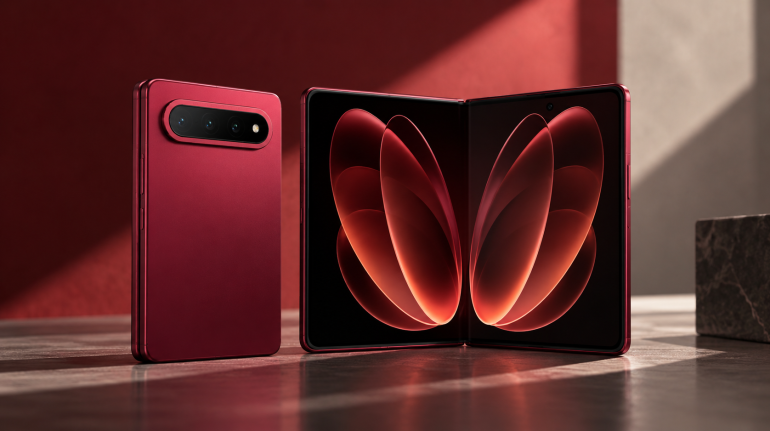
Xiaomi hasn’t officially launched the 18 Fold yet, but it has shown enough of the phone at IFA 2026 in Berlin that there isn’t much mystery left about what it’s trying to do. The company put the new foldable on display at its IFA stand this week ahead of its full launch in China on 7 September. It has a 5.38-inch screen on the outside, opens into a 7.58-inch display and uses a much shorter, wider shape than Xiaomi’s previous Mix Fold devices. Xiaomi is calling it a “mid-fold”, presumably because every slightly different phone shape now needs a name.
Whatever Xiaomi wants to call it, the shape itself is becoming increasingly familiar. Samsung’s Galaxy Z Fold8 arrived in July with a 5.5-inch outer screen and a 7.6-inch display inside. Huawei had already gone down a similar road with the Pura X and Pura X Max, and Apple is widely expected to unveil its first folding iPhone at its “Surprise and shine” event on 9 September. Apple hasn’t confirmed that a foldable will be there, but Bloomberg’s Mark Gurman reports that it will. Xiaomi’s 7 September event therefore lands exactly two days before Apple’s, and while the company hasn’t said the timing is deliberate, it’s hard not to notice it.
The Xiaomi itself looks good in the images from IFA. The deep red version shown in Berlin has a large horizontal camera housing running across the upper part of the rear panel, with three cameras and Leica branding. More importantly, Xiaomi has now started filling in the hardware details ahead of Sunday’s launch, and some of them are much more interesting than the fact that the phone folds.
The 18 Fold will use Xiaomi’s own 3nm XRING O3 processor rather than a Qualcomm Snapdragon chip and will also use LPDDR6 memory from Chinese manufacturer CXMT. Reuters reported last week that the phone will be the first Xiaomi flagship to combine the new XRING processor with CXMT’s LPDDR6, giving Xiaomi considerably more control over what sits inside one of its most expensive phones than it has had in previous generations.
Xiaomi has also confirmed a 6,000mAh battery, with 67W wired and 50W wireless charging. The battery uses 20% silicon content and Xiaomi claims an energy density of 920Wh/L, which is how it has managed to fit that capacity into a relatively compact foldable body.
For comparison, the Galaxy Z Fold8 I’ve been using for the past month has a 4,800mAh battery. A bigger number doesn’t automatically mean better battery life, particularly when Xiaomi is also introducing a new processor that hasn’t been independently tested in this phone yet, but an extra 1,200mAh is hardly insignificant. It’s also one of the few things about my Fold8 that I’d happily change. I’m still completely obsessed with the Samsung, as I said in my Fold8 review, but fitting everything into a phone that weighs 201g and measures only 4.5mm thick when open inevitably involved compromises, and battery size is one of them.
The Xiaomi also appears to have avoided another Fold8 compromise: the lack of a proper telephoto camera. Xiaomi says the rear camera system includes a 200MP main camera using a 1/1.56-inch sensor, a 50MP ultrawide and a 50MP periscope camera with 3.5x optical zoom. All three use Leica-branded optics. Xiaomi’s own sample photographs obviously tell us very little about how the cameras will behave once someone who isn’t Xiaomi gets hold of the phone, but at least the hardware is there and, on paper, it’s a reasonably serious specification for a device this size.
It’s also arriving at a particularly useful moment for Xiaomi because Samsung has already done some of the work of proving that people actually want this sort of Fold. The Galaxy Z Fold8 is quite different from the Fold phones Samsung has been selling since 2019. Rather than simply making the old design thinner, Samsung created a second Fold alongside the Fold8 Ultra. Closed, the Fold8 is roughly passport-sized. Open it and you get the wider display that has made the phone so much more pleasant to use than the tall, narrow Folds that came before it.
The response has been much stronger than Samsung’s previous foldables. According to Counterpoint Research’s analysis of Galaxy Z8 preorders, global Galaxy Z8 series preorders were more than 30% higher than the previous generation. South Korea was up 39%, Europe more than 20% and, in the US, where Counterpoint only had Fold data, preorders were up 30%.
The standard Fold8 is doing much of the work. Counterpoint says it accounted for around 70% of Z8 preorders in South Korea, nearly 50% in the US and almost 40% in Europe. The research firm also found that the Fold8’s lighter, wider design was attracting younger buyers and more women in South Korea, while more people in the US were moving from conventional phones and Flip devices to the Fold.
I’ve written before about why I think Samsung may have found a foldable sweet spot with the Fold8, and after actually living with one, I’m more convinced of it. The little outer screen is big enough for messages, maps, banking and the things I want to do quickly, while the inner screen is there when I want more space. The older Folds always felt like large phones that became tablets. This feels more like a small phone with a tablet hidden inside it.
None of that means Samsung invented the shape. Huawei had already begun playing with a much wider folding screen in March 2025 with the Pura X. It was an odd little device, essentially a flip phone turned sideways. It folded down to a compact square-ish shape with a 3.5-inch external display, then opened into a 6.3-inch screen with a much wider 16:10 aspect ratio than the flip phones we’d become used to.
Then came the Pura X Max in April this year. That phone takes the same basic idea and stretches it into something much closer to the Xiaomi and Samsung designs we’re looking at now. It has a 5.4-inch outer screen and 7.7-inch internal display, measures 85mm wide when closed and 166.5mm across when unfolded, and weighs 229g.
It has also sold surprisingly well. Counterpoint Research found that Pura X Max sales during its first five weeks in China were 29% higher than the Mate X7 over the comparable period, 49% higher than the original Pura X and 296% higher than the nova Flip S.
Huawei got that phone onto the market months before Samsung’s Fold8 and well before Xiaomi’s 18 Fold. I wrote about the Pura X Max when Huawei launched it in April because it was already obvious that several manufacturers were heading towards very similar proportions. The irritating part is that Huawei still hasn’t given the Pura X Max a global launch. Both Pura X models remain China-only, although I’m hoping that changes at some point because they’re interesting enough that people outside China should actually be able to buy them rather than just looking at them through YouTube videos and Chinese product pages.
Huawei has also done something else with the idea that I find almost as interesting as the foldables. The Pura X Viewdoesn’t fold, but it takes the same wide-screen thinking and applies it to a conventional smartphone. It has a 16:9.5 display ratio, whereas most modern smartphones have become extremely tall. Huawei has effectively taken the proportions it has been experimenting with on the Pura X family and removed the hinge.
Huawei’s own Pura X View page shows the extra horizontal space being used for reading, gaming, video, documents and even three-column social feeds. It looks slightly strange after more than a decade of increasingly tall smartphones, but so did the Fold8 when images first leaked. That phone now feels perfectly normal to me.
Apple may make the whole conversation much less niche next week. The company has confirmed its 9 September “Surprise and shine” event, while Bloomberg says Apple is preparing to introduce its first foldable iPhone alongside its other new products.
Apple, naturally, hasn’t said anything about the device itself. Current reports point towards a wide, book-style foldable with roughly a 5.5-inch screen when closed and around 7.8 inches inside. MacRumors’ current roundup of the folding iPhone puts it at roughly those dimensions, which would make it remarkably close to Huawei’s Pura X Max, Samsung’s Fold8 and now Xiaomi’s 18 Fold.
If it appears on 9 September, there will be the usual temptation to treat Apple’s arrival as the moment the category suddenly becomes real, but that would ignore quite a lot of phones that already exist. Oppo experimented with a shorter book-style Fold years ago, Google’s original Pixel Fold was unusually wide, Huawei went much further with the Pura X and then put the Pura X Max on sale in April, Samsung launched the Fold8 globally in July and has already recorded very strong early demand. Xiaomi’s version arrives on 7 September and Apple may be next two days later.
There’s still no indication that the Xiaomi 18 Fold will be sold in South Africa. Xiaomi has an established South African operation and sells phones, wearables and a growing range of smart-home products locally, but there’s currently no 18 Fold on the company’s South African site.
What I find more interesting is that these companies have reached broadly similar conclusions without producing identical devices. Samsung’s Fold8 is small and light, Huawei’s Pura X Max is considerably larger, Xiaomi is filling its version with a huge battery, a proper periscope camera and its own processor, while Huawei has decided the same proportions might also work on a phone that doesn’t fold at all.
For a smartphone market that spent years deciding almost every phone should be a very tall glass rectangle, I’ll take it.