
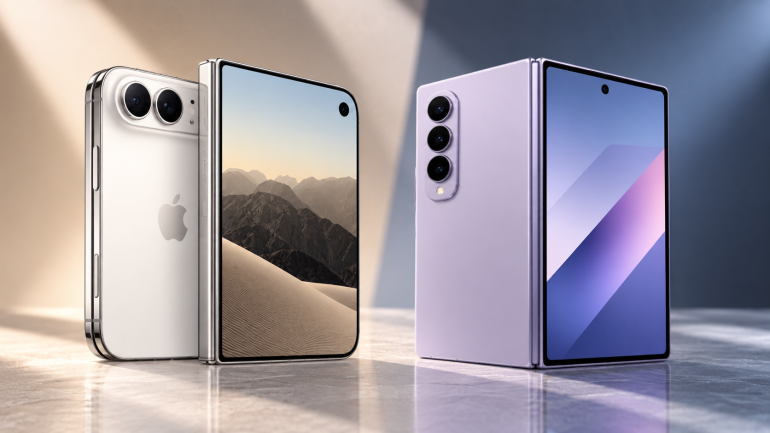
Apple has taken a predictably long time to make a folding iPhone. Samsung is already eight generations into the Galaxy Z Fold, Huawei has experimented with several different shapes and Google has had a few years to work out what Android should look like across two screens.
Apple hasn’t spent all that time ignoring foldables. Bloomberg reports that its hardware teams had been experimenting with folding phones, flexible displays and related components for years before Samsung launched the original Galaxy Fold in 2019. Tim Cook returned from a trip to Asia around 2020 particularly enthusiastic about the category after seeing more people using foldables from Samsung, Huawei and others, and pushed Apple to accelerate work that was already under way. Bloomberg’s account of the Duo’s development
That timeline makes the description of the iPhone Duo as roughly a decade in the making more sensible. Apple didn’t spend ten years developing this exact phone. The underlying work started earlier and the product that eventually became the Duo took shape later.
The phone Apple eventually settled on looks remarkably familiar.
Closed, the Duo has a 5.4-inch display. Open it and there’s a 7.6-inch screen inside. Samsung’s Galaxy Z Fold8 has a 5.5-inch cover display and, again, a 7.6-inch screen inside. Both have moved away from the tall, narrow proportions associated with earlier book-style foldables in favour of something shorter and wider that looks a little like a passport when it’s closed.
I’ve been using the Fold8 since I got it at Samsung’s Unpacked event in London in July and those proportions have made a much bigger difference than I expected. As I wrote in my Galaxy Z Fold8 review, the narrow cover displays on older Folds always felt like something I tolerated until I opened the phone. The Fold8 doesn’t. I use the outer screen for WhatsApp, email, banking and the other quick things I’d normally do on any phone, so opening it is something I choose to do when I want more space.
Buyers seem to like the change too. Counterpoint Research estimates that the standard Fold8 accounted for roughly 57% of Z8-series sales during its first two weeks, helping the range start 8% ahead of its predecessor despite higher smartphone prices. Counterpoint specifically points to demand for the new passport-style form factor as part of the reason.
That shape isn’t new. Oppo tried something similar with the original Find N in 2021, Google did it with the first Pixel Fold in 2023, and Huawei has continued pushing wider formats with devices including the Pura X and Pura X Max. I argued earlier this year that the wide fold isn’t a new idea, but the timing is finally right. The difference now is that hinges, batteries, chips and software have caught up enough that the shape no longer feels like the compromise.
Apple has arrived at much the same conclusion on its first attempt, although the similarities become less important once you look at the decisions surrounding them. Samsung has spent years stripping weight and thickness from its Fold. Apple has made a heavier device, but has also included several things Samsung has removed from the standard Fold8 or still hasn’t managed there.
iPhone Duo vs Galaxy Z Fold8: specs at a glance
| iPhone Duo | Samsung Galaxy Z Fold8 | |
|---|---|---|
| Outer display | 5.4-inch OLED, up to 120Hz | 5.5-inch Dynamic AMOLED 2X, up to 120Hz |
| Inner display | 7.6-inch OLED, up to 120Hz | 7.6-inch Dynamic AMOLED 2X, up to 120Hz |
| Weight | 254g | 201g |
| Thickness, folded | 11.3mm | 9.7mm |
| Thickness, open | 5.2mm | 4.5mm |
| Main cameras | 48MP wide + 48MP ultrawide | 50MP wide + 50MP ultrawide |
| Dedicated telephoto | No | No |
| Inner camera | Under-display | Visible camera |
| Stylus | USB-C Apple Pencil support coming later in 2026 | No S Pen support |
| Dust/water resistance | IP68 | IP48 |
| Exterior material | Grade 5 titanium | Armor Aluminium |
| Battery | Apple doesn’t disclose capacity | 4,800mAh |
| Storage | 256GB, 512GB, 1TB, 2TB | 256GB, 512GB, 1TB |
| US launch price | $1,999 | $1,899.99 |
| South African price | Not announced | From R40,999 |
Samsung’s eight generations show in the weight
The Fold8’s 201g weight is still one of the things that impresses me most about it. Samsung has managed to fit two screens, a hinge and a 4,800mAh dual-cell battery into something that doesn’t feel like a small tablet stuffed into my pocket.
It measures 9.7mm when closed and 4.5mm when open. The Duo is 11.3mm folded, 5.2mm open and weighs 254g, according to Apple’s specifications. Fifty-three grams is a substantial difference in something you’ll hold for hours and carry around every day.
Apple describes the Duo as its thinnest iPhone when it’s open. That’s true, although it isn’t necessarily the measurement I care about most on a foldable. For much of the day mine is closed, sitting in a pocket or being used one-handed.
Samsung’s engineering work becomes especially apparent when you look backwards. The company has taken the Fold from something that unmistakably felt like two phones joined together to a 201g device that weighs about as much as plenty of conventional flagships. That physical refinement is one area where Apple can’t skip eight generations simply by arriving later.
It’s also part of why I think the Fold8 has found something close to the foldable sweet spot. The phone no longer demands that you accommodate the hardware before you can enjoy the benefits of the larger display.
Apple has spent some of the additional weight differently. The Duo uses Grade 5 titanium for its enclosure, with Ceramic Shield on the rear and Ceramic Shield 2 over the outer display. Samsung uses Armor Aluminium around the standard Fold8, although there are two titanium reinforcement layers beneath its flexible display.
I’d still take the Fold8’s lower weight for daily use. Titanium is nice to have, but 53g is something I’m far more likely to notice after an hour of reading on the phone.
Apple hasn’t gone wild with the price
Foldables have conditioned us to expect unpleasant numbers and there was plenty of speculation that Apple would use its first one to establish another price tier somewhere comfortably above $2,000.
The Duo starts at $1,999 for 256GB in the US. Samsung launched the 256GB Fold8 at $1,899.99, while the larger Fold8 Ultra starts at $2,099.99. Samsung’s US launch announcement puts Apple almost perfectly between its two book-style foldables.
That changes the value discussion. Apple is charging roughly $100 more than the standard Fold8 while using titanium externally, offering IP68 protection and promising Apple Pencil support later this year. It also sells the Duo with up to 2TB of storage, while Samsung tops the Fold8 out at 1TB.
Counterpoint Research describes the Duo’s pricing as aggressive, which sounds strange when we’re discussing a $1,999 phone until you look at the rest of the category. Expectations before launch had Apple pushing beyond that figure, and the company could probably have done so knowing there’s an audience willing to pay heavily for its highest-end phones.
South African buyers can already get the Fold8 from R40,999. Samsung launched the Fold8 Ultra locally at R50,999. Apple hasn’t announced South African pricing for the Duo yet, so the local value comparison will have to wait.
Apple got to IP68 immediately
Samsung first added rated protection against solid particles to the Fold with the Galaxy Z Fold6 in 2024, moving from the Fold5’s IPX8 rating to IP48. The Fold7 kept IP48 and the Fold8 does too.
The Duo is IP68.
Both have the same rated level of water protection. The difference sits before the eight. Samsung’s IP4X rating provides protection from larger solid particles, while IP6X means Apple’s foldable is rated as dust-tight.
That’s a significant achievement on a first-generation product with a hinge and flexible display. Dust was one of the vulnerabilities that helped make the earliest foldables feel like devices you needed to treat differently from an ordinary flagship phone.
An IP rating doesn’t tell me how the Duo’s inner display will look after a year of use or how its hinge will cope after being opened thousands of times. Samsung has years of real-world experience that Apple doesn’t have yet.
Apple has still reached the level of dust resistance we expect from conventional flagships on its first folding phone, while Samsung has now stuck with IP48 across three generations.
Apple has revived the disappearing camera
Samsung introduced an under-display camera on the inner screen of the Galaxy Z Fold3 and kept it through the Fold4, Fold5 and Fold6. It was only 4MP and image quality was never particularly impressive, but that wasn’t really the reason for hiding it beneath the panel. When it wasn’t being used, the camera largely disappeared and left the big screen free of a black cut-out.
Samsung abandoned the idea with the Fold7 and the Fold8 uses a visible camera again.
Apple has decided the concept is worth revisiting. The Duo has a FaceTime camera sitting beneath the 7.6-inch screen, with Apple saying it stays hidden when it isn’t being used.
The more capable 12MP Center Stage camera remains on the outside, so Apple clearly isn’t pretending the internal one should be your first choice for photography. It’s there for video calls and the sort of quick interactions where keeping the display uninterrupted is more valuable than squeezing every bit of image quality out of a tiny camera.
Early hands-on impressions suggest the implementation is visually convincing, but the camera quality itself needs proper testing. Samsung had good reasons for abandoning its version.
It’s still slightly strange to see Apple revive something Samsung spent four generations trying to perfect just as Samsung has decided it would rather punch a hole in the screen again.
The Apple Pencil makes the missing S Pen look stranger
I’ve never really understood Samsung removing S Pen support from its recent Folds, although I can’t pretend its disappearance has materially changed the way I use the Fold8. I didn’t reach for the S Pen especially often on previous Folds, and I don’t even use it much on Samsung’s Galaxy S Ultra phones where the stylus lives inside the device.
Someone who bought a Fold partly because they saw it as a productivity tool might feel very differently.
Open the Fold8 and the proportions have an almost Moleskine-like quality to them. It feels like the sort of thing you should be able to pull out, jot something down on, annotate a document or sketch an idea before folding it shut and putting it back into your pocket.
Samsung has made the Fold feel more like a little notebook while removing the pen that would allow you to treat it as one. Samsung confirms the Fold8 doesn’t support the S Pen.
Apple has gone in the other direction. USB-C Apple Pencil support is coming to the Duo later this year and it’ll work on both screens. Apple specifically talks about taking notes, sketching and marking up documents, which seems an obvious use for a device that opens into a screen this size.
I don’t suddenly expect to become someone who carries an Apple Pencil everywhere simply because an iPhone folds. I’m glad Apple sees the value in supporting one, particularly for people who already use foldables as portable workspaces.
Samsung has removed one of its old foldable tricks
Flex Mode used to be one of Samsung’s better examples of why a hinge could do more than simply make a big screen fit into your pocket. Partially folding older Folds could move content onto one half of the screen and controls onto the other, or prop the phone up for photography, video calls and watching something without needing a stand.
The standard Fold8 doesn’t support it.
Samsung says the new hinge is optimised for fully open and fully closed use, with the flatter unfolded display taking priority over partially folded positions. That’s an engineering choice rather than a forgotten software toggle, but it removes an interaction Samsung spent years teaching people to associate with its foldables.
Apple has built posture into the Duo’s software from the start. iOS 27 reacts as the phone folds, reorients content and switches to the appropriate display depending on how it’s being held. The Duo can also prop itself up for FaceTime, photography and video, while StandBy works on either screen even when the phone isn’t charging. Apple’s software overview shows how deeply those positions have been built into iOS 27.
Some third-party apps go further and change their layouts depending on how the phone is positioned. That makes the hinge part of the interface rather than simply the mechanism connecting one screen state to another.
Samsung helped establish that idea. The Fold8’s flatter main display may prove more useful to more people, but losing partially folded use is still an unusual trade for a company with this much experience in the category.
Apple and Samsung disagree about what the two screens are for
Both phones have 7.6-inch inner displays and outer screens separated by only 0.1 inches. Both support adaptive refresh rates up to 120Hz. The similarities end once you look at their proportions.
Samsung treats the two screens as different things. The Fold8’s 10:16 cover display is shaped more like an ordinary phone, while opening it produces a broad 4:3 canvas. Samsung has deliberately given the screens different proportions because they’re intended to do different jobs.
After living with it since July, I think that approach makes sense. I don’t use the two screens in the same way. The outside is for scrolling, replying to something or checking an app quickly. The inner display is where I’m more likely to read something long, edit a photo or place apps next to one another.
Apple has prioritised continuity instead. The Duo’s two displays share the same aspect ratio, so whatever you’re looking at can scale proportionally as the device opens and closes. That should make moving between screens feel less like an app has suddenly been poured into a different-shaped container.
The inner screen also gets a nano-texture finish that Apple says reduces glare and reflections while making the crease less visible. Early hands-on accounts have been positive about how difficult the crease is to see in normal use.
I’m wary of turning that into a claim that Apple has “solved” the crease. Samsung has made a substantial improvement with the Fold8 too, and Oppo has been working on the same problem. My Fold8’s crease already fades from my attention as soon as I stop looking for it and start using the phone.
Apple waited until that physical fold stopped being the defining annoyance of a foldable before releasing one. That’s a considerably easier category to enter than the one Samsung had to create.
Apple’s software may be the bigger surprise
Samsung should have an overwhelming advantage in foldable software simply because it has been doing this for so long. One UI on the Fold8 is excellent at making the larger display useful, with mature multitasking, Multi Window and years of decisions shaped by people actually using Fold devices.
Apple hasn’t tried to recreate all of that.
iOS 27 has instead been altered around the Duo in smaller ways that add up quickly. Navigation and app controls move towards the sides to preserve vertical space. The Dynamic Island has been redesigned to sit vertically along the edge. Content reacts while the phone is physically folding instead of waiting for the transition to end. The display engine can drive both screens simultaneously.
Split View lets two apps run next to one another on an iPhone for the first time. You can open two windows from the same app, swap applications around and save app pairs. Apple says Netflix, Zoom and Slack are already adapting their interfaces for the Duo.
Samsung still gives you more freedom and its multitasking is already proven. I’m particularly interested in what happens outside Apple’s own apps, though. Some Android software still looks as if it has been given a large Fold screen without anybody telling it what to do with the extra room.
Apple has years of iPhone and iPad development behind it, which means a lot of developers already think about how the same software should behave at different sizes. Counterpoint thinks that combination of iOS 27 and Apple’s developer ecosystem could become one of the Duo’s stronger advantages.
That needs to be proven once the phone is actually in people’s hands. What Apple has shown so far suggests it has thought about the fold as part of iOS rather than simply making an iPhone screen larger.
Both companies have compromised on cameras
Samsung gives the Fold8 a 50MP main camera and 50MP ultrawide. The Duo gets a 48MP main camera and 48MP ultrawide, with both phones relying on a crop from their primary sensors for 2x optical-quality magnification rather than fitting a dedicated telephoto camera.
I’ve found the Fold8’s cameras good during the time I’ve spent with it, sometimes very good. I wouldn’t call them one of the reasons to buy the phone and I miss having proper telephoto reach far more than I miss the S Pen.
Apple’s decision becomes harder to ignore because of what it launched alongside the Duo. The iPhone 18 Pro models introduce a new variable-aperture 48MP main camera that can physically adjust its aperture. The Duo doesn’t get it.
Apple therefore had newer camera hardware available for this generation and chose not to put all of it into its most expensive new iPhone form factor. Samsung has done something similar by reserving its more ambitious foldable camera system for the Fold8 Ultra.
Space inside a foldable is genuinely difficult. The hinge, dual batteries and extremely thin halves all compete for room with camera sensors. That explains the compromise. It doesn’t make it particularly satisfying on phones costing $1,899.99 and $1,999.
Both make good use of having a second display for photography. The Duo can show the person you’re photographing a preview, use its rear cameras for higher-quality selfies and prop itself up for longer exposures or video. Samsung has spent years doing variations on the same idea.
I’d still rather have the telephoto.
Battery life could matter more than benchmark scores
The Fold8 uses Qualcomm’s Snapdragon 8 Elite Gen 5 for Galaxy, while the Duo gets the same A20 Pro chip Apple puts into the iPhone 18 Pro models.
Neither is going to struggle with WhatsApp.
The more useful question is whether either company has managed to make using the large screen feel normal without punishing the battery. Samsung fits a 4,800mAh dual-cell battery into the Fold8. Apple doesn’t disclose the Duo’s capacity but has placed a battery in each half of the phone and says software dynamically balances energy between them.
Apple claims up to 31 hours of video playback using the inner display, 44 hours on the outer display and up to 24 hours when both screens are used equally. Those figures come from Apple’s own testing and shouldn’t be compared directly with Samsung’s numbers because the companies test differently.
My Fold8 comfortably gets me through the sort of normal day I’d expect from a flagship phone, although keeping the big screen open for long periods obviously asks more of the battery.
Foldables have reached a point where I don’t think users should have to ration the very feature they paid all this money for. A 7.6-inch screen isn’t especially useful if opening it immediately makes you think about the nearest charger.
Ecosystem may decide this before the hardware does
The comparison becomes less rational once you’ve spent years buying things around your phone.
I’ve been more tempted to move fully to the Fold8 than I expected because I genuinely enjoy using its inner display. There’s still a reason I haven’t, and it has less to do with Samsung’s hardware than with everything surrounding my iPhone.
An Apple Watch, AirPods, a Mac, iCloud and years of habits make switching smartphones a different decision from comparing camera resolutions and screen sizes.
Samsung has built its own version of that ecosystem around Galaxy Watches, Buds, tablets, PCs and SmartThings. Somebody who’s already invested there isn’t likely to abandon all of it because Apple’s dust rating is better.
The Duo changes the equation for people already on Apple’s side. Until now, an iPhone user who wanted a proper book-style foldable had to leave iOS. They no longer have to make that choice.
That could end up being more consequential than most of the hardware differences between these phones.
Foldables are still niche, but 100 million of them isn’t nothing
Apple is entering a very different category from the one Samsung stepped into in 2019. Foldables remain a small part of the smartphone market, but there are now enough of them in circulation for manufacturers to have learnt which compromises buyers will tolerate.
Counterpoint expects cumulative global foldable shipments to pass 100 million units by the end of 2026. They still account for only around 2% of the overall smartphone market, but the research firm expects shipments to grow another 37% in 2027 as Apple joins Samsung, Huawei and the rest of an increasingly crowded group.
The wider book-style shape is part of that change. Counterpoint says demand is shifting towards wider designs from Samsung and Huawei, while the Fold8’s early sales suggest Samsung’s redesign wasn’t merely aesthetic.
That echoes what I found after spending time with the phone. The Fold8’s wider proportions make it more useful precisely because they stop asking the user to adapt to the hardware. It behaves more like a normal phone when closed and gives you something meaningfully different when opened.
Apple has had years to see the same evidence.
There’s no need for a conspiracy about one company copying another’s proportions. Supply chains leak, companies study competing products and engineers across the industry are trying to solve many of the same physical problems. If a foldable needs to work well as a normal phone when closed and become genuinely useful when opened, there are only so many sensible shapes it can take.
The more revealing thing is that Samsung spent generations changing the Fold until it arrived here, while Apple waited and entered the market at roughly the same destination.
Apple learnt from Samsung, including some things Samsung has since removed
Samsung did much of the awkward work on foldables in public. The early Galaxy Folds were thick, narrow and visibly experimental. The company had to learn how to build stronger hinges, make folding screens survive ordinary life and convince software developers that these strange dimensions were worth supporting.
Eight generations later, I can carry a Fold8 that weighs 201g and use it like an ordinary smartphone until I decide I want a much larger screen.
That refinement shouldn’t be understated simply because Apple has arrived.
The Duo is substantially heavier and thicker. Samsung’s multitasking is already mature. I know how the Fold8 behaves after living with it since July, while nobody outside Apple has had enough time with the Duo to tell us what becomes annoying after six weeks.
Apple has also walked into the category with an IP68 rating while Samsung remains at IP48. It has put an under-display camera back beneath the inner screen after Samsung abandoned one. Apple Pencil support is coming while the Fold8 no longer works with the S Pen. iOS understands partially folded positions just as Samsung has removed Flex Mode from the standard Fold.
Then there’s the price. The titanium Duo costs $100 more than Samsung’s aluminium Fold8 and $100 less than the Fold8 Ultra.
None of those things makes the Duo the better foldable before I’ve even used one. The Fold8’s 53g weight advantage alone may turn out to matter to me more than several of Apple’s headline advantages combined.
What Apple’s first attempt does show is the benefit of arriving late. It has been able to look at which compromises became accepted simply because foldables were difficult to make, then decide which ones it still wants its buyers to accept.
Samsung has spent eight generations making the Fold extraordinarily refined. Apple has entered at generation one and already found a few areas where Samsung may have refined something useful away.