
Samsung now accounts for almost one in three smartphones shipped across the Middle East and Africa. According to Counterpoint Research’s Q2 2026 MEA smartphone data, regional shipments fell 10% year on year while Samsung’s share increased from 22% to 32%. Samsung became much larger inside a market that had become considerably smaller.
There wasn’t a sudden rush of new demand for Samsung to capture. Counterpoint says the quarter lacked the sales-driving occasions that had been concentrated into Q1, while Infinix, TECNO and Xiaomi lost ground as Samsung, realme and Apple grew. In that environment, Samsung’s gains came largely from demand its competitors were no longer capturing, which makes its performance less about the smartphone market recovering than about which companies are best equipped for the conditions it has entered.
Those conditions are particularly difficult at the cheap end. Smartphone shipments below $250 fell 26% year on year, the worst performance of any price band, as the continuing memory shortage pushed manufacturers to ration constrained components towards devices with healthier margins. Counterpoint says Transsion, which owns TECNO and Infinix, and Xiaomi were particularly exposed because so much of their volume sits in precisely the segment taking the hardest hit.
The result can look like premiumisation when viewed from far enough away, but the word hides very different consumer experiences. Some people are choosing more expensive smartphones because they want better devices, while others are encountering a market in which the phones they would ordinarily buy have become more expensive or harder to find. Counterpoint’s own analysis argues that MEA is being pushed up the price curve partly by component scarcity rather than simply by people deciding they want to spend more.
Samsung is unusually well placed for this market
Samsung doesn’t need every customer to respond to higher prices in the same way. Counterpoint specifically credits the Galaxy A07 and A17 with performing well during the quarter alongside the S26 flagship range, allowing Samsung to take demand at the affordable end while continuing to sell some of the region’s most expensive mainstream smartphones.
That breadth becomes more valuable when competitors are struggling to supply entry-level devices. A customer who would previously have bought an inexpensive Xiaomi, Infinix or TECNO doesn’t have to jump to a R20,000 Galaxy for Samsung to benefit from the disruption because the A-series is already waiting much further down the price curve. Samsung can then offer increasingly expensive devices as that customer’s needs or budget change without asking them to leave Galaxy along the way.
Counterpoint argues that winning those customers back can become more difficult once they’re inside Samsung’s ecosystem. That shouldn’t be overstated because price remains enormously important across MEA and ecosystem attachment means different things at R3,000 and R30,000, but Samsung does have years of familiarity and distribution working in its favour alongside operator relationships and a product range that stretches across most of the market.
The South African market offers a useful example of why that breadth matters. Omdia reported that South African smartphone shipments grew 17% year on year in the first quarter of 2026, with average selling prices up 4% to $369 as Samsung’s premium ecosystem and HONOR’s expansion in the upper mid-range helped support higher-value sales. In the same report, Omdia warned that Africa’s ultra-affordable smartphone segment faces a much harder year as memory inflation, supply-chain costs and purchasing-power pressure bear down on the sub-$200 market.
That makes HONOR’s recent growth across Africa much more interesting when placed next to Samsung’s Q2 numbers. HONOR has been building volume while also moving further into the upper mid-range and premium parts of the market, which gives it somewhere to go if the economics of selling the cheapest smartphones keep deteriorating.
The latest MEA figures also show how difficult that climb remains. Counterpoint’s Q2 chart puts HONOR at 6% share, up from 5% a year earlier, while Samsung moved from 22% to 32%. HONOR is growing, but it’s trying to build a version of a ladder Samsung has spent much longer constructing.
The Magic V6 puts HONOR directly into Samsung’s territory
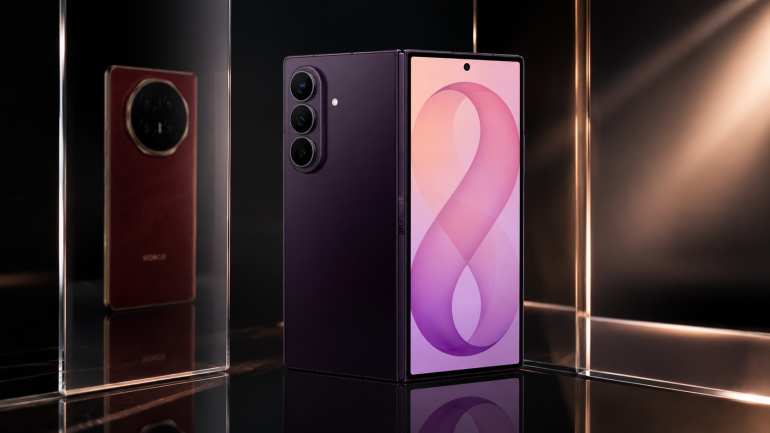
That strategy became unusually visible in South Africa this week when HONOR launched the Magic V6 at R39,999. The book-style foldable goes on sale locally from 1 September and sits within R1,000 of the Galaxy Z Fold8’s R40,999 starting price, which means HONOR isn’t merely arguing that it can build an excellent folding phone. It’s asking South African buyers to put its brand into the same purchase decision as Samsung at roughly R40,000.
HONOR doesn’t need the Magic V6 to generate enormous sales volumes for that positioning to be useful. A device at the very top of its portfolio can influence how buyers perceive the less expensive phones underneath it, particularly if the hardware can credibly compete with products from brands that have occupied the premium end for much longer.
Samsung has already shown why that part of the market is worth fighting over. Global pre-orders for the Galaxy Z8 series increased by more than 30% compared with the previous generation, while European pre-orders rose by more than 20%during the first 11 days after launch. The wider Fold8 accounted for almost 40% of European Z8 pre-orders, suggesting Samsung’s less conventional book-style design is reaching beyond the audience that had already decided it wanted a Fold.
The South Korean response was even more striking. Samsung says its new foldables recorded 1.44 million pre-orders in seven days, a Galaxy smartphone record, with roughly seven in ten preorder customers choosing the Fold8. Half of the buyers purchasing through Samsung.com were in their teens through 30s, while purchases of the Fold8 and Fold8 Ultra by women in that age group more than doubled compared with the Fold7 generation. Those are Samsung’s own store figures rather than independent market data, but they suggest the company is reaching people who hadn’t previously fitted the stereotype of a book-style Fold buyer.
That experience was apparent during my own month with the Galaxy Z Fold8. The Fold8 became the first Android device in years that seriously tempted me to move away from the iPhone, and the thing stopping me wasn’t Samsung’s hardware. Apple’s ecosystem and the handful of iPhone-specific things I still rely on remain a larger obstacle than anything Samsung has done wrong with the device.
That hesitation becomes much more consequential if Apple is finally about to sell a folding phone of its own.
Apple could remove the ecosystem decision
Apple has confirmed a special event for 9 September, but it hasn’t said what products will be announced. Reporting around the event points towards the next iPhone Pro models and Apple’s long-rumoured first foldable iPhone, although the product itself, its specifications and the unofficial “iPhone Ultra” name remain unconfirmed until Apple puts something on stage.
Its launch geography is even less certain. MacRumors has reported on claims that the foldable could launch in the US firstbefore expanding into other markets over the following months because of supply and production constraints. The original report hasn’t been corroborated strongly enough to treat a US-only first release as settled, and there’s no firm information yet about whether South Africa would be included in an initial rollout.
Even a limited first release could change the competitive logic of foldables. Until now, an iPhone owner attracted to something like the Fold8 has had to decide whether the hardware is appealing enough to justify moving away from iOS at the same time. An Apple foldable would let that customer change the shape of their phone without changing the ecosystem around it.
Counterpoint currently expects global foldable smartphone shipments to grow 21% in 2026, with Samsung projected to remain the largest manufacturer at 32% share. Apple is forecast to take 25% in its first year, Huawei 24%, Motorola 8% and HONOR 3%. Forecasts made before Apple has even announced the product should be treated accordingly, but the numbers show how much demand researchers believe Apple could unlock from customers who’ve been sitting outside the category.
The forecast is even more aggressive in North America. Counterpoint expects Apple to capture 46% of North American foldable shipments in 2026, while Samsung’s share is projected to fall from 51% in 2025 to 29%. Counterpoint attributes much of that expected growth to Apple being able to tap its existing iPhone customer base at the ultra-premium end rather than having to persuade people to switch platforms first.
Samsung has also spent years doing much of the awkward work required to make book-style foldables easier to live with. Early devices were thick, heavy and saddled with narrow outer displays that constantly reminded you of the compromise you’d accepted, while the Fold8’s short, wide design feels deliberately different rather than simply compromised.
That helps Apple because it may be entering after the basic proposition has already become familiar. Samsung has had to persuade people that a phone which opens into a small tablet can be useful, while Apple could begin with millions of existing iPhone customers who already understand the category and were simply unwilling to leave iOS to participate in it.
South Africa could feel Apple’s influence before getting the phone
If Apple does limit its first folding iPhone release to the US or a handful of markets, its immediate effect on South African smartphone sales would obviously be small. Its effect on interest in foldables could arrive much sooner because an Apple launch would put book-style devices in front of an enormous audience that has previously been able to ignore them as something Android manufacturers do.
That could temporarily work in Samsung and HONOR’s favour. A South African iPhone owner could watch Apple explain why a folding phone is useful and then discover that the premium versions available locally are Samsung’s Fold8 family and HONOR’s Magic V6, giving both Android manufacturers a period in which Apple potentially creates curiosity around their category without immediately competing for the sale.
Samsung would probably be better placed to convert that interest because it already has a large premium customer base and a much broader local presence. HONOR would gain something different because Apple entering the category could make foldables feel less like unusual Android hardware and more like an established part of the premium smartphone market.
The calculation changes once Apple eventually sells a foldable here. Samsung would then face something it hasn’t really encountered during the years it has spent developing the Fold: a direct book-style competitor backed by an ecosystem with at least as much ability to keep customers attached as Samsung’s own.
My reluctance to move away from the iPhone despite how much I enjoy using the Fold8 is exactly the kind of friction an Apple foldable would remove. Samsung could build an excellent foldable and still lose some potential buyers simply because those customers would no longer have to choose between the form factor they want and the operating system around which the rest of their devices are organised.
HONOR faces a different problem because it’s still building premium brand recognition rather than defending a category it helped establish. Apple entering foldables could make the Magic V6’s category feel considerably more legitimate while simultaneously putting another enormously powerful brand into the same ultra-premium conversation HONOR is trying to join.
The premium fight is happening while the bottom gets harder
The tension underneath all of this is that an increasingly valuable premium smartphone market doesn’t necessarily tell us anything reassuring about the financial position of the average consumer. MEA’s sub-$250 shipments fell 26% during the same quarter in which 5G smartphone shipments grew 8%, with Samsung and Apple providing much of that increase.
Those movements can coexist without describing the same person. Someone buying a R40,999 Fold8 because they want a folding tablet in their pocket and someone postponing an upgrade because affordable smartphones have become harder to buy can both contribute to a market moving upwards in price, even though one represents genuine demand for premium hardware and the other reflects shrinking affordability.
Omdia’s African outlook makes that split harder to dismiss. Its May research described the sub-$200 market as being under growing pressure from memory costs, supply-chain expenses and weaker purchasing power, while South Africa remained comparatively resilient because higher-value purchases and operator financing were supporting demand further up the market.
That’s where Samsung’s current strength becomes particularly difficult for competitors to reproduce. It can benefit when cheap-device rivals struggle because it has the A-series, while the S and Z ranges give it access to customers prepared to spend much more. HONOR is trying to establish a similarly broad proposition, but Samsung begins that contest with a 32% regional share and a much larger pool of existing customers.
Apple complicates the picture from above. If its folding iPhone appears on 9 September, Samsung will still have the advantage of years of foldable experience and HONOR will still have aggressively engineered hardware such as the Magic V6, but Android manufacturers will lose one of the easiest ways they’ve been able to distinguish themselves from the iPhone.
Samsung’s extraordinary Q2 therefore says something less comfortable than the usual market-share victory story. The company is benefiting from a smartphone market being squeezed upwards from below while it successfully sells increasingly expensive devices at the top, but the premium territory that makes that position so valuable is becoming harder to own.
The 32% share tells us who is best equipped for the MEA smartphone market as it exists now. What happens when cheaper supply eventually recovers and Apple joins HONOR in pressing harder at the expensive end will tell us whether Samsung has merely taken advantage of an unusually distorted year or built a lead its competitors will struggle to unwind.